Product Descriptions
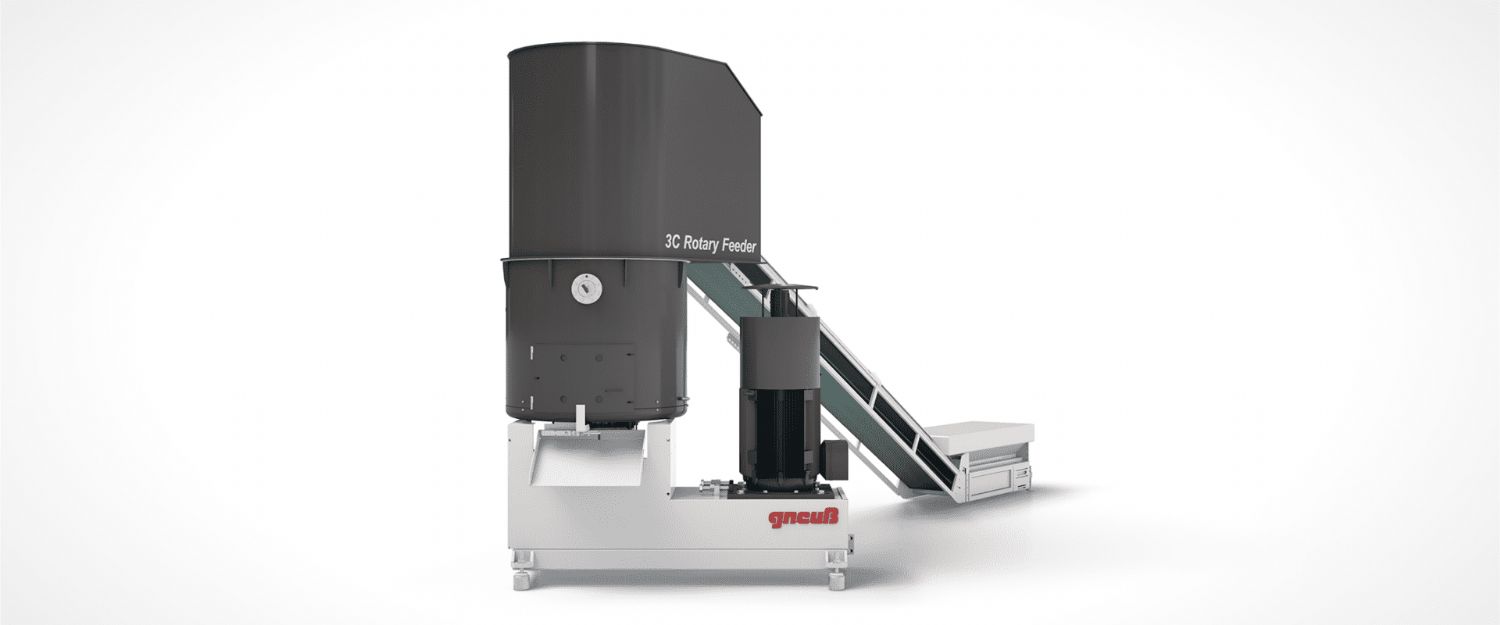
GNEUSS 3C Rotary Feeder Technology
The GNEUSS 3C Rotary Feeder is an advanced feeding system developed for the efficient processing of materials with low bulk density in plastic recycling and extrusion processes. It ensures the stable feeding of difficult-to-handle raw materials such as plastic film waste, fiber bales, foamed plastics, and other recycling materials with low bulk density into the extruder system.
Before entering the extrusion process, the 3C Rotary Feeder processes the material through three stages: Cutting, Compacting, and Conditioning. Through this three-stage process, the plastic material is prepared in an optimal form for extrusion, significantly improving process stability.
This technology delivers particularly high performance when used in plastic recycling lines, OMNI series recycling systems, and in combination with MRS extruder technology.
Operating Principle of the 3C Rotary Feeder
The 3C Rotary Feeder system uses an integrated process consisting of several stages to prepare plastic waste for the extrusion system.
The system generally operates as follows:
Plastic waste is pre-shredded if necessary using a shredder.
The shredded material is transferred via conveyor belt to the 3C Rotary Feeder feeding hopper.
Inside the feeder drum, high-speed rotating discs and blades cut and compact the material.
Mechanical energy transfer causes the material to heat up and surface moisture to be removed.
The prepared plastic material is then automatically fed into the extruder system.
During this process, the plastic material is both densified and conditioned to the appropriate temperature and process state required for extrusion. This ensures a homogeneous feed at the extruder inlet and improves overall process stability.
Cutting - Compacting - Conditioning (3C) Technology
The name 3C Rotary Feeder is derived from the three core processing stages:
Cutting
Compacting
Conditioning
During the cutting stage, rotating blades divide the plastic material into smaller pieces.
During the compacting stage, the material is compressed to increase its bulk density. This process is particularly important for the extrusion of low-density materials such as plastic films and fibers.
During the conditioning stage, mechanical energy slightly heats the material and removes surface moisture. As a result, plasticization during the extrusion process occurs more quickly and efficiently.
Technical Specifications of the 3C Rotary Feeder
The GNEUSS 3C Rotary Feeder system is available in various model options designed to match different extruder sizes.
Main technical specifications include:
Screw diameter: 70 - 200 mm
3C unit motor power: 55 - 200 kW
Extruder motor power: 110 - 860 kW
Machine dimensions vary depending on the model.
Typical machine dimensions:
Extrusion height: 1150 - 1450 mm
Machine length: 1850 - 3500 mm
Machine width: 1200 - 1970 mm
Machine height: 2700 - 3250 mm
Approximate machine weight depending on the model:
3900 - 5600 kg
In complete systems including shredder and conveyor belt units, the total line length can reach approximately 7.3 - 7.7 meters.
Processable Material Types
The 3C Rotary Feeder system can process a wide range of materials. By combining cutting, compacting, and conditioning processes, it provides a wide processing window for extrusion operations.
Typical materials that can be processed include:
PET film and bottle flakes
PP and PE plastic film waste
PS foam blocks
Polyester fiber bales
Plastic textile waste
Plastic packaging waste
Thermoformed plastic products
Injection and blow molding parts
Thanks to this wide material compatibility, the system can be used both in industrial plastic waste recycling and post-consumer plastic recycling applications.
Integration with Extrusion Systems
The 3C Rotary Feeder system is typically used in combination with the following extrusion technologies:
MRS Extruder
MRSpure Extruder
MDS Extruder
When combined with these extrusion systems, the 3C Rotary Feeder functions as a high-performance pre-feeding system in plastic recycling lines.
Through this combination, plastic materials are processed within a single integrated process where they are:
cut
densified
preheated
prepared for degassing
fed into the extrusion system
This integrated structure significantly increases the efficiency of modern plastic recycling lines.
Advantages of the 3C Rotary Feeder System
The GNEUSS 3C Rotary Feeder system offers numerous advantages in plastic recycling processes.
Key benefits include:
processing of low bulk density materials
stable extruder feeding
reduction of pre-drying requirements
improved process stability
high production capacity
energy-efficient operation
wide material compatibility
In addition, the system maintains stable extrusion performance even when processing variable input materials. This feature provides a major advantage in post-consumer plastic recycling.
Application Areas of the 3C Rotary Feeder
The 3C Rotary Feeder system has a wide range of applications in the plastics recycling and polymer processing industries.
Typical applications include:
plastic film recycling
PET recycling
polyester fiber recycling
thermoformed plastic recycling
plastic packaging recycling
plastic foam recycling
industrial plastic waste recycling
The system is primarily used to optimize material preparation and feeding processes in plastic recycling lines.
3C Rotary Feeder in Plastic Recycling Lines
In modern plastic recycling facilities, the stable feeding of raw materials into the extrusion system is critically important. When low-density plastic waste is fed directly into the extruder, process instability may occur.
3C Rotary Feeder technology eliminates this problem by preparing the material under ideal conditions for the extrusion process.
As a result:
extrusion stability increases
energy consumption decreases
recycling efficiency improves
final product quality is enhanced
Today, GNEUSS 3C Rotary Feeder technology is considered an essential component of high-efficiency extrusion lines in the plastic recycling industry.