Product Descriptions
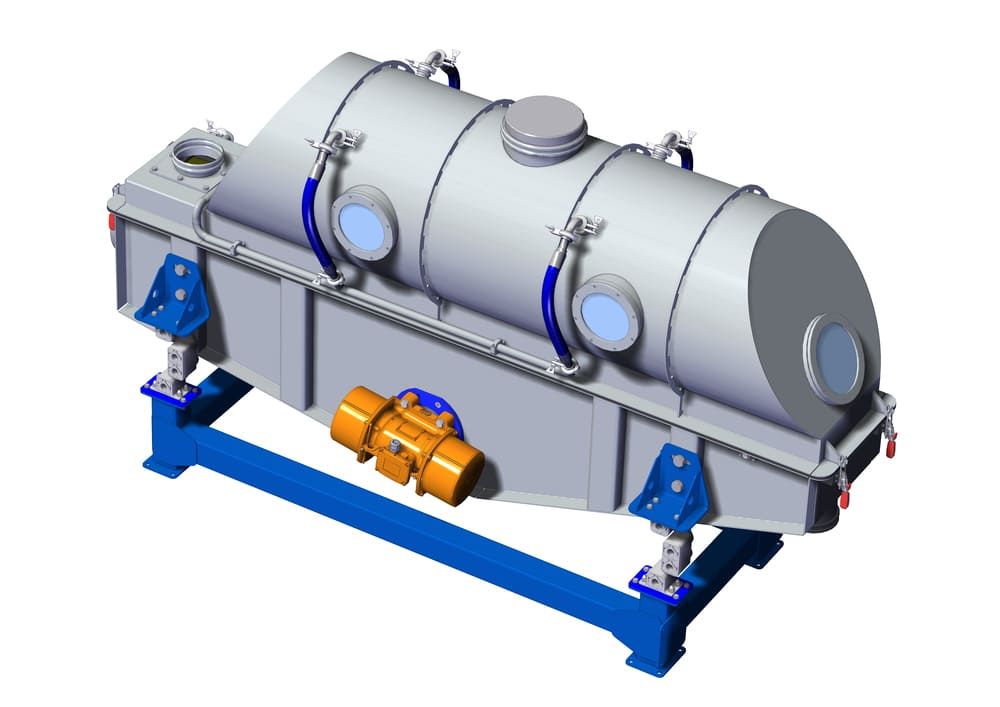
Vibrowest LF Fluidised Bed Dryers - Technical and Detailed Product Description
Vibrowest LF (Fluidised Bed) dryers are advanced engineering systems developed for the continuous and controlled drying of powders, granules, crystals, and free-flowing solid materials. By using fluidised bed technology, the product is suspended and gently agitated within a stream of air or inert gas. This enables homogeneous and rapid heat transfer, making the system suitable not only for drying but also for cooling, crystallisation, or granulation processes. LF dryers are ideal solutions for industries that require high product quality, hygiene, and precise process control, such as food, chemical, pharmaceutical, paper, recycling, plastics, and metallic powder sectors.
Fluidised bed drying is achieved by introducing hot air or gas upward through a perforated grid located at the bottom of the dryer. This creates a "fluidised bed" in which the material behaves similarly to a liquid. Vibration or vibration-assisted airflow enhances fluidisation, optimises heat transfer, and ensures that moisture is removed quickly and uniformly from the product, resulting in consistent and homogeneous drying.
General Structure and Main Components
The main components and engineering structure of Vibrowest LF fluidised bed dryers include:
• Fluidised bed housing: the main drying chamber manufactured from high-temperature-resistant materials
• Perforated grid: ensures uniform distribution of air or gas across the product bed
• Vibration unit: supports effective fluidisation of the product within the bed and improves heat transfer
• Air or gas flow control system: enables precise control of temperature, flow rate, and residence time
• Exhaust gas filtration system: filters dust and moisture-laden air to ensure environmental and process compliance
• PLC / touchscreen control panel: allows digital adjustment and monitoring of all process parameters
This structural configuration allows operation in both batch and continuous production modes and can be customised according to specific process requirements.
Operating Principle
The operating principle of LF fluidised bed dryers is based on enabling the product to exhibit fluid-like behaviour through air or inert gas flow:
• Fluidisation: hot air or gas introduced from the bottom flows upward through the perforated grid, lifting the material and creating a dynamic fluidised bed
• Vibration assistance: vibration reduces the fluidisation pressure required for denser or more compact materials, optimises energy consumption, and enhances heat transfer
• Heat transfer: direct contact between the product and the heat-carrying gas ensures rapid and uniform heat transfer
• Drying: the desired moisture level is achieved by adjusting temperature, air velocity, and residence time
• Exhaust and filtration: used air is discharged through filtration or energy recovery systems in an environmentally compliant manner
This flexible design also allows additional processes such as cooling, granulation, or crystallisation to be carried out within the same fluidised bed.
Process Control and Parameters
The main process parameters that can be controlled in LF dryers include:
• Temperature ranges: adjustable inlet and outlet temperatures of the drying air
• Air or gas flow rate: critical for effective product fluidisation
• Residence time: the duration the product remains inside the dryer
• Pressure and flow control: essential for energy efficiency and process stability
By optimising these parameters according to the physical and thermal properties of the product, final product quality, moisture content, and overall process efficiency are significantly improved.
Technical Features and Performance
Vibrowest LF dryers are built on a modular and fully customisable architecture. Typical design and performance characteristics include:
• High heat transfer efficiency achieved through fluidised bed technology
• Reduced fluidisation pressure due to vibration or vibratory assistance
• Precise drying enabled by controlled temperature and humidity profiles
• Operating modes: batch or continuous production
• Integrated air/gas filtration and energy recovery systems
• Easy integration with automatic feeding and discharge systems
• Digital process control via PLC or SCADA with real-time monitoring
These features make LF dryers particularly suitable for thermally sensitive materials and quality-critical processes.
Application Areas
Vibrowest LF fluidised bed dryers can be used across a wide range of industries:
• Food industry: powders, granules, additives, and dried products
• Pharmaceutical industry: active ingredients and crystallised products
• Chemical industry: drying of chemical powders and granules
• Recycling: drying processes for plastic and metallic powders
• Agriculture and minerals: moisture control of grains, fertilisers, and mineral materials
• Plastics and 3D powders: moisture removal after thermal processing
This wide application range makes the LF series ideal for both in-line production drying and overall process stabilisation.
Key Advantages
The most notable advantages of LF fluidised bed dryers include:
• Homogeneous and controlled drying
• Energy optimisation through controlled airflow and heat recovery
• Modular design adaptable to different production capacities
• Easy integration with automated systems
• CIP (Clean-In-Place) capability for easy cleaning and hygiene
• Digital process control with real-time monitoring and adjustment
Vibrowest LF fluidised bed dryers are advanced process equipment designed to meet modern industrial drying requirements. With fluidised bed technology, vibration assistance, digital process control, and modular design, they maximise product quality while improving energy efficiency and process reliability. Thanks to their broad range of industrial applications and high performance parameters, the LF series provides a powerful engineering solution for drying, cooling, and moisture control of a wide variety of materials.