Product Descriptions
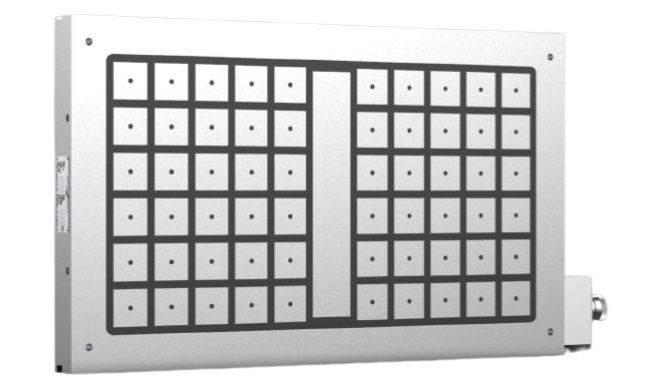
Rivi Workholding (M-Tecs W) Magnetic Clamping Systems
Precision, Powerful and Flexible Workpiece Clamping Technology for CNC Machining and Grinding Applications
The M-Tecs W Workholding Series developed by Rivi Magnetics consists of high-performance permanent magnetic clamping systems designed for CNC machining centers, milling machines, grinding machines and precision metal cutting applications. By eliminating the access limitations, setup times and tolerance issues caused by conventional mechanical clamping devices, these systems clamp the workpiece homogeneously over its entire surface, significantly improving both machining accuracy and productivity.
The M-Tecs W series is particularly advantageous in low-tolerance machining, multi-surface material removal and applications where re-positioning must be minimized. In 5-axis CNC machining centers, it allows access to five of the six faces of a workpiece in a single setup, dramatically reducing cycle times.
Operating Principle and Magnetic Clamping Technology
In M-Tecs W systems, clamping force is generated through a closed-loop magnetic field created by permanent magnets. The magnetic field is evenly distributed across the table surface, ensuring that the workpiece is fixed not at isolated points but across the entire contact area.
Thanks to this homogeneous clamping principle:
Local stresses within the workpiece are reduced
Vibration and micro-movement are minimized
Cutting tool life is extended
Surface quality and dimensional accuracy are improved
The magnetic system consumes energy only during magnetization and demagnetization. During machining, energy consumption is virtually zero.
M-Tecs W Series Product Versions
POLAR 50
Pole structure: Square pole
Pole size: 50 × 50 mm
Clamping force per pole: 350 daN
Ideal for thin and small-surface workpieces
High surface contact for low-thickness parts
POLAR 70
Pole structure: Square pole
Pole size: 70 × 70 mm
Clamping force per pole: 750 daN
Suitable for thick, large and irregular workpieces
Deep magnetic field penetration using pole extension elements
MOON
Simple and monolithic design
High magnetic reliability
Specifically developed for grinding machines
Ideal for stable clamping of flat and thin parts
Technical Performance and Numerical Data
Magnetic clamping force
350 daN per pole (POLAR 50)
750 daN per pole (POLAR 70)
Magnetic plate thickness
55 mm (POLAR 50)
67 mm (POLAR 70)
Table dimensions
Wide configuration range from 250 mm to 1000 mm
Magnetization / demagnetization time
1 - 2 seconds
Energy consumption
Only during magnetization and release
Mold / workpiece modification
Not required
Control Units and Safety Architecture
M-Tecs W systems operate with MTM / MTR electronic control units. These control units provide:
Single or multiple magnetic table management
Standard control of up to 8 channels
Safety signal integration (machine operation inhibited if magnet is inactive)
Remote control for magnetization and demagnetization
System monitoring via current sensors
The CNC machine cannot operate unless the magnetic clamping status is verified. This architecture ensures maximum operator and machine safety.
Production Advantages in CNC and Grinding Applications
Dramatic reduction in setup and clamping times
Complete elimination of mechanical clamping devices
Maximum cutting tool accessibility
Multi-surface machining in a single setup on 5-axis machining centers
Reduced need for workpiece repositioning
Higher surface quality and dimensional precision
Extended tool and machine service life
These advantages provide a significant competitive edge, particularly for manufacturers engaged in high-value precision machining.
Application Areas
CNC machining centers
Milling machines
Grinding machines
5-axis machining applications
Mold and model manufacturing
Precision mechanical components
Steel and ferromagnetic alloys
Conclusion
Rivi Magnetics M-Tecs W Workholding magnetic clamping systems represent an advanced technology that combines speed, precision, safety and production flexibility in machining and grinding applications. By surpassing the limitations of mechanical clamping solutions, these systems constitute a strategic investment for manufacturing facilities requiring multi-surface machining, tight tolerances and consistently high quality.