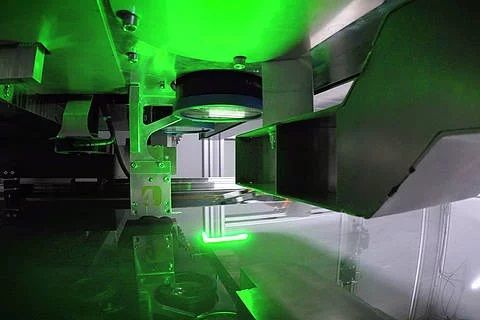
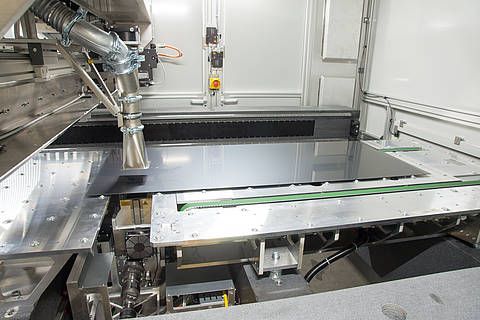
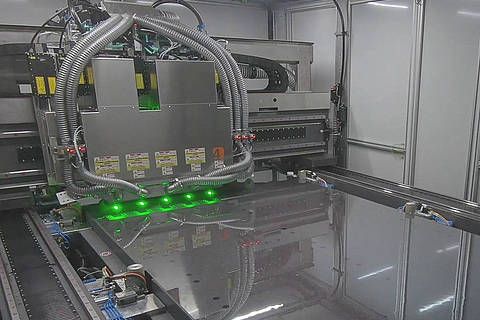
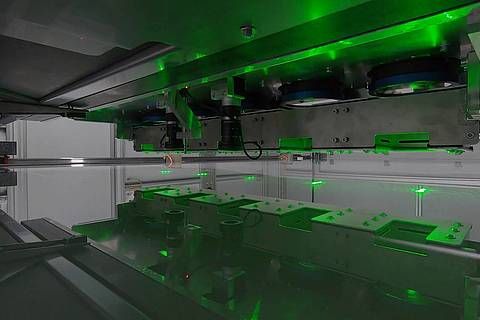
TOPAZ - SYSTEM FOR LASER STRUCTURING OF GLASS
Whether in automotive glass, photovoltaics, architectural glass, or consumer electronics - high-quality coatings on glass are enabling ever better displays, smart windows, efficient solar cells, as well as light and heat management in vehicles. In the post processing of glass substrates a key task is partially ablating the functional layers without affecting the neighboring film or the substrate glass.
Typical applications include, for example, the structuring of thin conductive layers, or the removal of surface areas during edge deletion.
Depending on the task, fine features must be ablated with the highest precision from the glass- or the layer side. Different coating systems require adapted process parameters and the selection of suitable wavelengths and pulse regimes. Short cycle times, residue-free processing and fully digital production without tool change are additional requirements. Our TOPAZ series includes the most powerful portfolio of high-precision laser systems for ablation of thin films. Depending on the task, the systems can be flexibly configured: for different formats, the use of one, two or five scan heads, process control from the layer side or in transmission and more.
TOPAZ PX SCRIBING SYSTEMS: VERSATILE SOLUTIONS FOR PRECISION MACHINING
TOPAZ Px scribing systems are available in two different versions: one is designed for processing from below the substrate through the glass and the other is designed for processing from above directly on the coating side. In general, our TOPAZ Px systems can be equipped with a wide range of different laser sources offering a variety of laser wavelengths and pulse characteristics to achieve optimal results for your P1, P2 and P3 scribing processes. All processes can be performed either through the glass or from the film side to achieve the best possible application results.
INDIVIDUAL AUTO FOCUS
TOPAZ Px Scribing Systems offer several impressive features that directly impact your success:
individual focus control per beam: fully compensate for substrate deformations to achieve precise results every time.
highest available throughput: increase production speed and thus the amount of PV modules manufactured.
INDIVIDUAL PATH TRACKING
individual path tracking: minimize the dead zone and make the best use of every square inch of substrate for energy production.
minimum possible downtime and maintenance: reduce downtime to an absolute minimum to keep your production running smoothly
INDIVIDUAL POWER BALANCING
individual power control per beam: achieve identical scribe lines across the entire panel for unmatched product quality.
shortest cycle times: Speed up the manufacturing process and increase your efficiency.
maximum laser utilization with minimum non-productive time: Make maximum use of lasers by reducing non-productive times to a minimum and eliminating unnecessary waiting times.
SPECIFICATION
Processes P1, P2, P3 scribing from either substrate-side or from film-side
Thin film materials PV layer stacks such as CdTe, Perovskite and CIGS
Laser sources ns, ps and fs laser in IR, Green or UV
Working area (x, y) up to 2.400 mm x 1.300 mm; others on request
Substrate dimensions Customer specific within machine working area specification
Glass thickness 2 mm up to 4 mm, others on request
Position accuracy +/- 10 µm
Particle extraction High volume flow, high pressure, high efficiency filtering
4JET'S TOPAZ BIPV - HIGH PRECISION, HIGH FLEXIBILTY, HIGH SPEED MADE BY SCANNING ON THE FLY
Our TOPAZ Building Integrated PV machines are unique when it comes to accuracy, flexibility and speed. High precision, high flexibility, high speed achieved by scanning on the fly and the possibility of parallel use of up to 6 processing heads - even for complex contours. This results in previously unknown accuracies and homogeneous and fast machining of even large surfaces.
With TOPAZ BIPV, you can rely on high-precision absorber or full-stack structuring, as well as the ability to create logos and images that make your application unique. Bet on the future of Building Integrated PV technology with TOPAZ.
TOPAZ LED - PRECISION AND EFFICIENCY IN PV MODULE EDGE DELETION
The TOPAZ LED is equipped with a variety of innovative components that are part of an optimized system that maximizes precision and efficiency in the edge deletion of PV modules. The belt conveyors were developed specifically for glass transport and the LED process and are characterized not only by their cost efficiency, in that complex and expensive linear grippers can be dispensed with entirely. They are also characterized by the achievable speeds, the robustness, and the associated highest possible uptime of the machine. Granite for long-term Stability and Accuracy
A key advantage of the TOPAZ LED is the use of granite in its structure, which ensures high temperature stability and eliminates vibrations, resulting in the highest precision. The processing head, which is the heart of the machine, is moved by a high-precision linear axis and has an impressive sensor system for edge detection and tracking, also achieving the highest processing accuracies. In addition, an autofocus system is also implemented, through which inaccuracies of the substrate are compensated and thus consistently excellent results are achieved around the entire circumference of the substrate. The optical design of the processing head with the integration of fiber-coupled lasers offers flexibility, minimum maintenance time and precision even at high processing speeds to ensure optimal edge deletion.
The Topaz LED is the result of all the experience we have gained as the unmatched leader in laser edge deletion since 2006. It is a high-quality yet cost-effective solution for the efficient production of thin-film PV modules and continues the success. 4JET'S
TOPAZ LS/GS - PRODUCTIVITY & VERSATILITY COMBINED
VERSATILITY FOR GLASS OR LAYER SIDE LASER PATTERNING
4JET's TOPAZ LS/GS is the most versatile solution for laser patterning applications where handling of flat glass sheets is not that critical. These systems are made for a reliable 24/7 production. High resolution and high accuracy are further attributes that make these systems the ideal choice, especially if glass side (GS) laser patterning is required for higher throughput and best product quality, especially in architectural, automotive or technical glass applications. However, by simply flipping the laser patterning head granite beam and axis upside down, the system is transformed into a layer side (LS) patterning TOPAZ.
Accuracy and Dynamics
The TOPAZ LS/GS series is based on a granite gantry with one or two separate linear y-axis, gripping the substrate on one or respectively two sides and moving it back and forth at high speed in the system. A stationary granite bridge carries the linear x-axis and can be mounted either above or below the substrate, hence enabling layer side (LS) or glass side (GS) patterning. The system configuration allows the movement of the substrate back and forth for patterning, while the laser patterning head(s) rests, or the moving of the laser patterning head(s) while the glass rests. The latter promises the highest accuracy because any glass sheet vibration is avoided.
Furthermore, the movement of a compact patterning head provides higher dynamics. The beam path is relatively short for a stable and thus accurate beam position across the substrate. The glass substrate is supported against bending during its movement to provide stability and in particular a stable focus plane for the laser. The system's robustness, vibration dampening capability and stability, especially in terms of long-term accuracy is achieved by the granite and its low coefficient of temperature expansion (CTE) - being four times smaller than the one of steel. This enables and guarantees a sustainable production of high-precision and high-quality products.
Scanning-on-the-fly: The High-speed Core of the TOPAZ LS/GS
Depending on the required pattern resolution and the cycle time requirements the patterning axis can be equipped with multiple scanners, operating in the scanning-on-the-fly mode which increases the machine's throughput and reduces production costs.
The laser wavelength and pulse length and thus the laser source is chosen according to the specific requirements of the application for best product quality and taking intoaccount economical aspects. Additional optional features like e.g. the TOPAZ DYNAMIC FOCUS provide additional means to achieve an optimal product quality, e.g. in case the incoming glass substrate deviates from a flat shape.
4JET'S TOPAZ LS - IDEAL FOR THIN GLASS SHEETS
PATTERNING FROM THE LAYER SIDE, EVEN ON THINNEST GLASS
4JET's answer to layer side patterning applications, especially on thin and hard to handle glass sheets or flexible substrates - the TOPAZ LS! The LS systems have been designed as reliable 24/7, high performance, high resolution, high accuracy inline laser systems for the patterning of functional coatings on substrates from the layer side (LS), whether the application is technical, architectural or transportation glass.
Granite for long-term stability and accuracy
Our TOPAZ LS is based on a gantry structure in which the x-axis bridge is stationary and firmly connected to the machine bed. A substrate table is moved back and forth by the y-axis. This system design has the advantage of shorter beam paths for a stable and therefore accurate beam position on the substrate. The gantry configuration is always preferred when the laser cannot be moved due to its size and/or weight. In addition, the substrate can be fixed on the table, which also provides a stable and uniform surface for laser structuring, even on the thinnest glass substrates. The table can be switched from fixing into transporting mode to allow the substrate to be transported in or out of the system. The gantry configuration is twice as long as the substrate in transport direction.
THE HEART OF THE TOPAZ LS
Depending on the required pattern resolution and the cycle time requirements the patterning axis can be equipped with multiple scanners, operating in the scanning-on-the-fly mode which increases the machine's throughput and reduces production costs.
The laser wavelength and pulse length and thus the laser source is chosen according to the specific requirements of the application for best product quality and taking into account economical aspects. Additional optional features like e.g. the TOPAZ DYNAMIC FOCUS provide additional means to achieve an optimal product quality, in case the incoming glass substrate deviates from the flat shape.
4JET'S TOPAZ 3D - LASER PATTERNIG OF CURVED GLASS
MADE FOR COATED WINDSHIELD PATTERNING IN OEM PRODUCTION LINES
To achieve high quality coated windshields, it is preferred to introduce the patterning for creating RF-transmission filters and decoated areas for a clear camera view after the furnace respectively bending. For this specific application, 4JET provides a solution which is unique on the market. Made for 24/7 operation in OEM windshield production lines, 4JET's TOPAZ 3D can introduce fine-line patterns and an area removal at the same time across the curved windshield in a glass-to-glass cycle time below 30 s. How to achieve OEM cycle times
Within the TOPAZ 3D, no axes are moved to reach the different positions on the windscreen, which would sacrifice cycle time for each movement (step and repeat mode). Instead, the position of the laser processing head is fixed and the scanner addresses a large scanning field of about 1.2 x 1.2 m². This not only 2D, the laser focus is also moved dynamically in the 3rd dimension. Thus, the TOPAZ 3D can structure almost any shape from flat to strongly curved windscreens.
On the one hand, a very high laser focus speed is achieved with this remote scanning approach which effectively reduces the laser time, on the other hand, the non-productive times must be optimized for OEM cycle times. This is achieved by reducing the movement of the windshield to the processing position and back to a simple rotation. Invisible to the eye
A special optical beam path design together with precise laser pulses accomplish very fine patterning lines. The line width can be adjusted in a wide range.
The glass-side ablation process in the TOPAZ 3D achieves best patterning results for a product quality, as needed for premium-grade windshields such as heated/coated models combined with head-up-displays.
Precision, even with complex 3D shapes
A camera-based fiducial referencing system makes sure that the features are placed onto the windshield with a high accuracy and repeatability, regardless of how good or bad the substrate has been placed onto the conveyor before entering the machine.
All these features make the TOPAZ 3D the ideal candidate for high volume OEM production lines, i.e. > 500.000 windshields per year.
4JET'S TOPAZ G - SMART WINDOW PATTERNING
HIGH SPEED PATTERNING FOR SMART WINDOW MANUFACTURING
Our TOPAZ G is a tailor-made system for layer-side structuring of TCO electrodes on Smart Windows with high throughput and very high resolution.
Managing a tight focus
First of all, it is important to mention that the Smart Window glass pane to be laser structured has a length of more than 3 m, but its thickness is only about 1 mm. An even greater challenge to the patterning process is the fact that the structure width to be produced is sometimes less than 10 µm, with a total tolerance of less than 2 µm over this large glass pane. This is the only way to ensure that the pattern is invisible to the human eye. As a result of this structure width, the theoretical depth of focus of the laser beam at a spot size of 10 µm (1/e²) is less than 150 µm.
To meet these challenges, the glass pane is fixed on a large, flat granite table. In addition, the topology of the granite table is determined and the focus of each patterning head is adjusted accordingly during patterning.
This ensures long-term stable structuring conditions for a sustainable quality of the final product. Remember, the final product is a window and the human eye is not easily fooled.
The Heart of the TOPAZ G
Two aspects accomplish the required throughput of the TOPAZ G, one is parallelization, the other one is scanning on-the-fly. Parallel scanning is accomplished with of 5 single patterning heads. All of them extremely well calibrated in their own working area as well as with regard to each other and the linear axis system. Scanning on-the-fly means the laser beam is deflected at high speed by a 2D scanner while the axis system moves the patterning head. This mode of operation achieves an unmatched throughput compared to standard step-and-repeat approaches.
Accuracy and throughput at the next level for a scalable and economical smart window production. The TOPAZ G - a benchmark for large area patterning.