SCANNECT - 2D Code Reading Bridge, Automatic 2D Code Reading on Tires
2D CODE READING BRIDGE
AUTOMATED 2D CODE READING ON TIRES
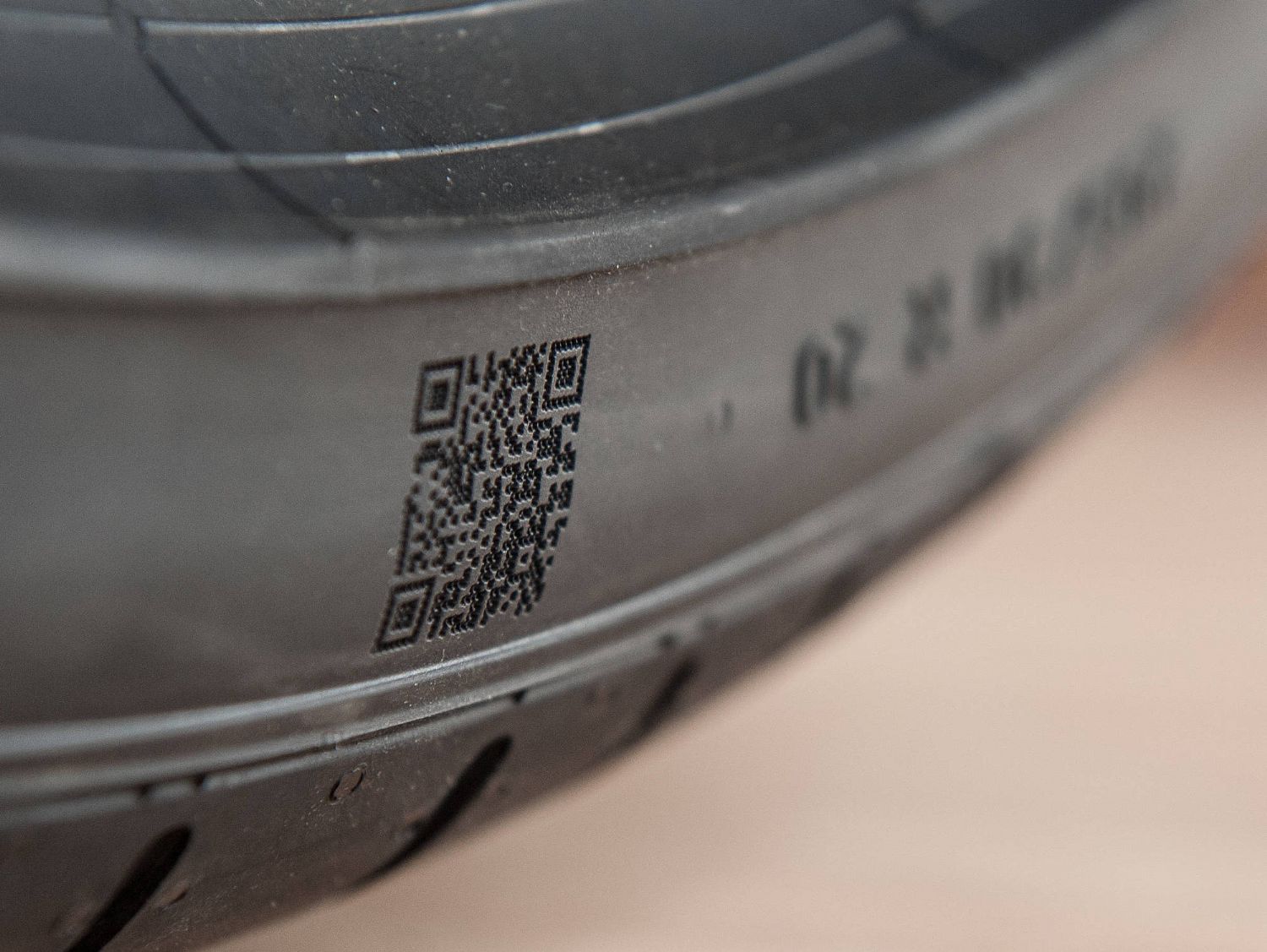
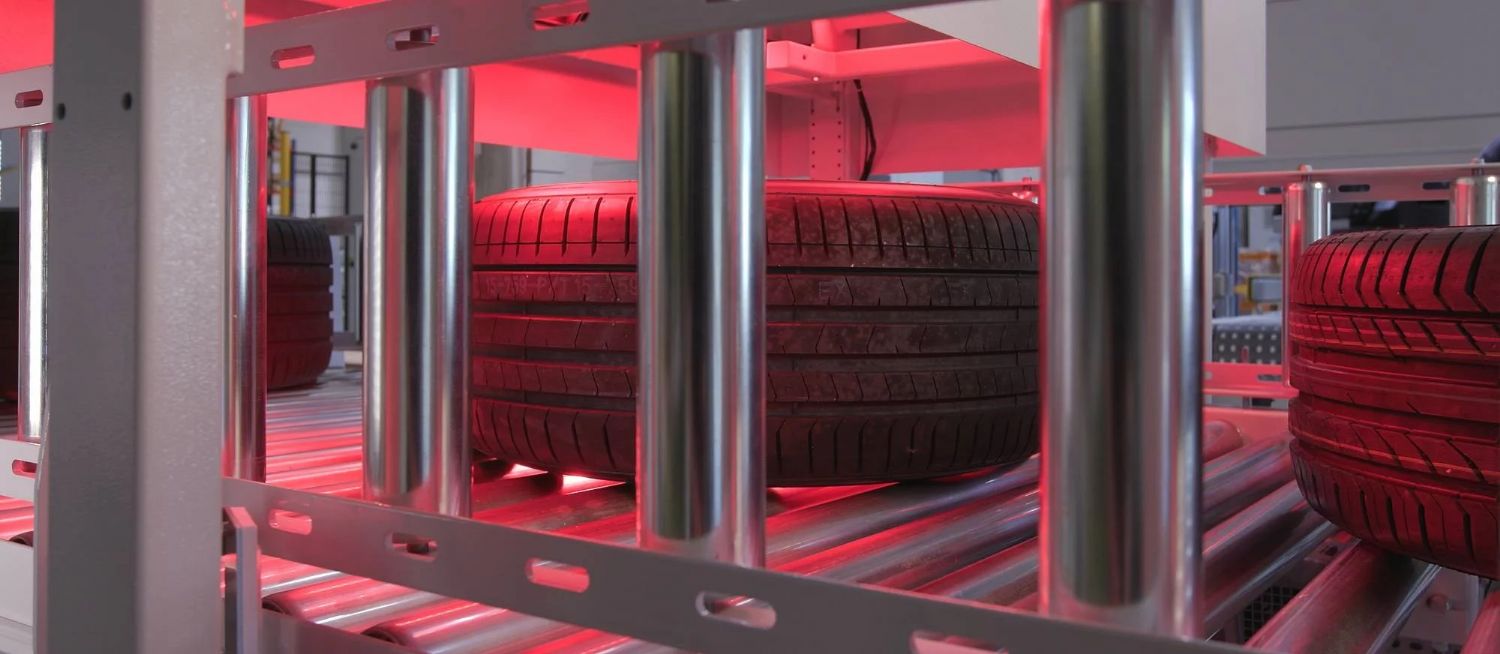
The SCANNECT 2D Code Reading Bridge is a system for automated reading of 2D codes on tires which are being moved by a conveyor system. With an optimized camera and lighting setup and intelligent software, the reading bridge can reliably read black codes on black surfaces. This makes it the ideal choice for reading SCANNECT codes on tires, for example in automated wheel assembly lines or tire manufacturing.
FAST, RELIABLE, HIGH READ RATES
While standard 2D code scanners are well suited to read SCANNECT codes, they are typically not able to cope with the high requirements of automated reading tasks. High conveying speeds, a broad range of tire geometries, the special black-on-black codes and expected read rates of well above 99% represent a challenge that is not mastered by off-the-shelf systems.
The SCANNECT reading bridge simultaneously operates several high performance cameras with ultrafast focus adaption which allows to cover a wide range of tire widths. The extra bright lighting enables ultra-short shutter speeds and high depth of field at the same time. Therefore, the system can deal with conveyor speeds up to 700 mm/s. The advanced image processing algorithms are tailor-made for the special black-on-black SCANNECT codes as well as the curvature and angle of a tire sidewall.
With these features, reading rates of well above 99.8% for 4JET SCANNECT codes on sidewalls with angles of up to 30° are achieved.
The system can be remotely accessed and software settings can be adopted to new or advanced requirements. Pictures are being stored by the system for several weeks in order to easily analyse system performance. The advanced image processing algorithms are tailor-made for the special black-on-black SCANNECT codes as well as the curvature and angle of a tire sidewall.
With these features, reading rates of well above 99.8% for 4JET SCANNECT codes on sidewalls with angles of up to 30° are achieved.
The system can be remotely accessed and software settings can be adopted to new or advanced requirements. Pictures are being stored by the system for several weeks in order to easily analyse system performance.FROM DOT WEEK CODE MARKING TO
THE INTERNET OF THINGS
Tires have a significant influence on the performance and safety of our vehicles. And tires will be one of the few remaining wear parts in an electric vehicle. Accordingly, tires are actually ideally suited for networking in the "Internet of Things": Data from tire sensors can be used to derive tire pressure, grip or slip, the remaining tread depth or even information about the road condition. A quantum leap for production control, vehicle safety, driving behavior and tire serviceability seems possible if powerful MEMS sensors can provide a variety of tire data via RFID signals.
However, despite high expectations and although repeatedly announced, this vision has not yet been technologically implemented in the market and the vast majority of tires remain offline and anonymous:
To date, the tire industry, with its OEM customers and tire/wheel assembly providers, has not created an industry standard that would connect an intelligent tire to the factory or vehicle via RFID signals. And even worse: the DOT week code used since 1971 and embossed on the sidewall remains the only globally standardized method of tracking tires.
In other words, while digitalization continues at lightspeed in automotive manufacturing, modern passenger car tires still do not even have an individual and permanent serial number, let alone connectivity: the barcode labels, some of which are used in factories, are hidden under the rim of the tire after installation and are not robust enough to survive the tire's lifetime. Tire labels on the tread recently introduced in the EU are only suitable until the first use and a broad adaptation of RFID has so far failed for a number of reasons, including the high cost per tire, significant problems in defining an industry standard, a difficult patent landscape and in many cases perhaps too ambitious goals. AUTONOMOUS DRIVING AND EFFICIENT TIRE MANAGEMENT
At the same time, the megatrends in the automotive industry such as autonomous driving, electric vehicles and the sharing economy require a "know your tire" function for modern cars. Many tire characteristics can already be derived very easily from tire type and age or better from the individual tire history without equipping the tire with sophisticated and expensive sensor technology. Accordingly, driving performance data based on the individual iyre history are collected and allow the adjustment of driving assistance systems and chassis parameters to the individually fitted tire.
More and more and larger vehicle fleets, not only in the commercial vehicle sector, require professional tire management with the key function of being able to identify the individual tire and thus enable preventive maintenance.
And the tire manufacturers have identified these trends, which will be the focus of their market strategy in the coming years. Downstream integration of offerings such as "Tire-as-a-Service" models to strengthen customer loyalty, improved tire performance and increased value creation are on the agenda of all major tire manufacturers.
IMMEDIATE ACCESS TO THE INTERNET OF TIRES
For this reason, more than 90% of the world's networked car tires are now based on 4JET SCANNECT technology. This robust and very cost-effective solution, which can be easily introduced on any existing tire, provides immediate access to the Internet of Tires. The SCANNECT laser marking of machine-readable 2D codes can be complemented by the engraving of human-readable serial numbers, making it the ideal medium to interact directly with the end customer or via his preferred interface, the smartphone.
In addition, the technology can be used to engrave production week codes (DOT week codes) to bypass the manual, costly, error-prone and safety-critical process of replacing mold inserts. NEW LEVEL OF FLEXIBILITY
With the 2D matrix-coded tires required by OEMs, laser tire marking is becoming a standard process in tire production. From a cost perspective, the process favors multi-marking strategies with very low marginal costs for additional markings. Machine or human-readable information for tracking can be combined with other markings, which leads to a significant reduction of tire manufacturers' inventory and offers a new level of flexibility in tire production.