CIGS Module Production with MPCT Integrated High Speed Production Tool
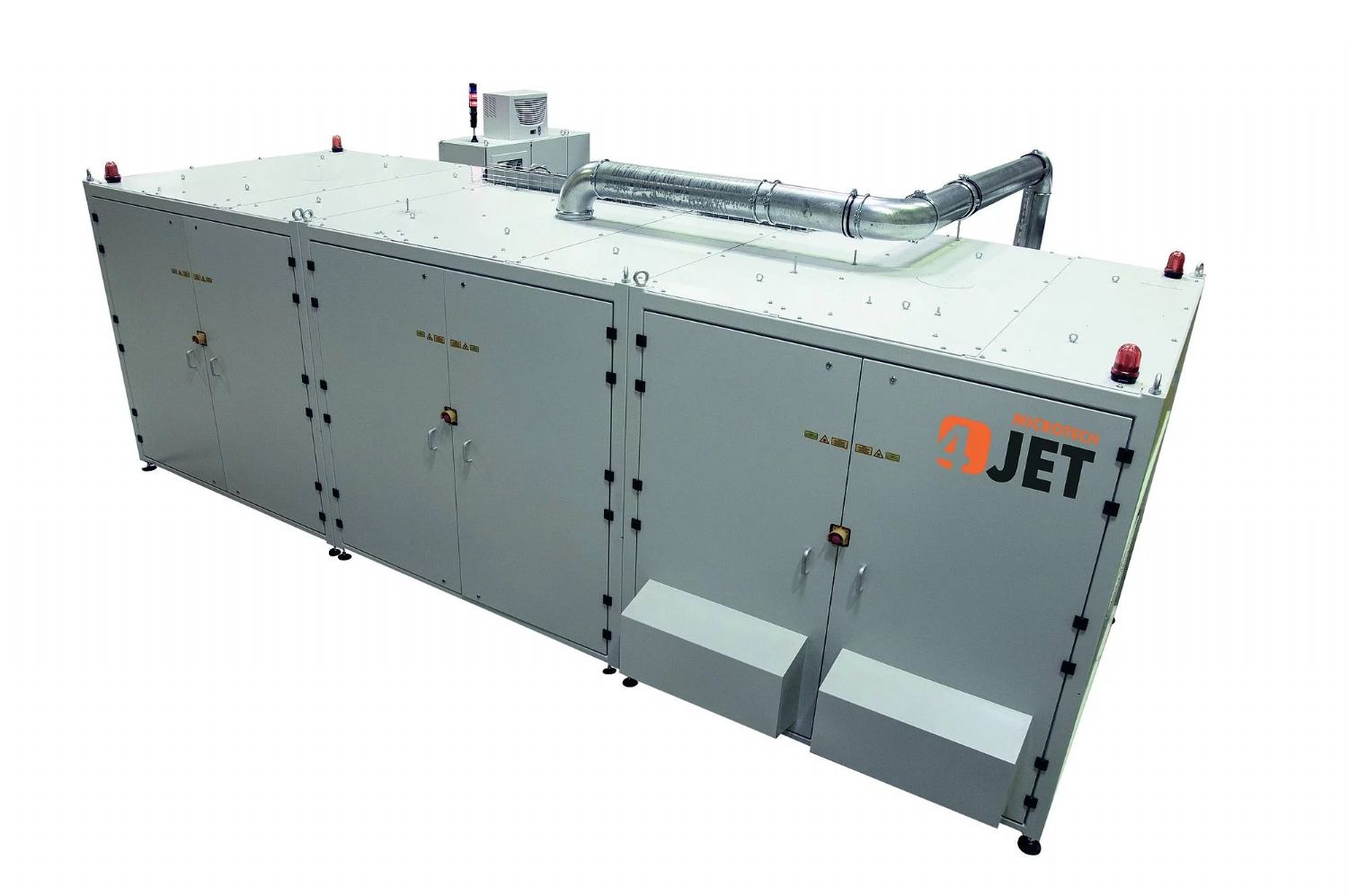
4JET'S MPCT
INTEGRATED HIGH-SPEED PRODUCTION TOOL FOR CIGS MODULE PRODUCTION
4JET's MPCT has been specially designed for high speed CIGS solar thin-film module production. The tool combines 3 processes within one system providing highest throughput and reliability with a minimum footprint. The combination of laser edge deletion (LED), molybdenum exposure (MEX) and glass drilling (GDS) in one system reduces the requirements for glass transporting and alignment of the thin-film modules and thus provides the best combination of robustness and throughput minimizing capital investment and operation costs.
Our MPCT is designed for 24/7 inline production of CIGS-based thin-film solar modules with a minimum of maintenance requirements. It achieves the highest throughput in its class. Highest productivity on a small footprint
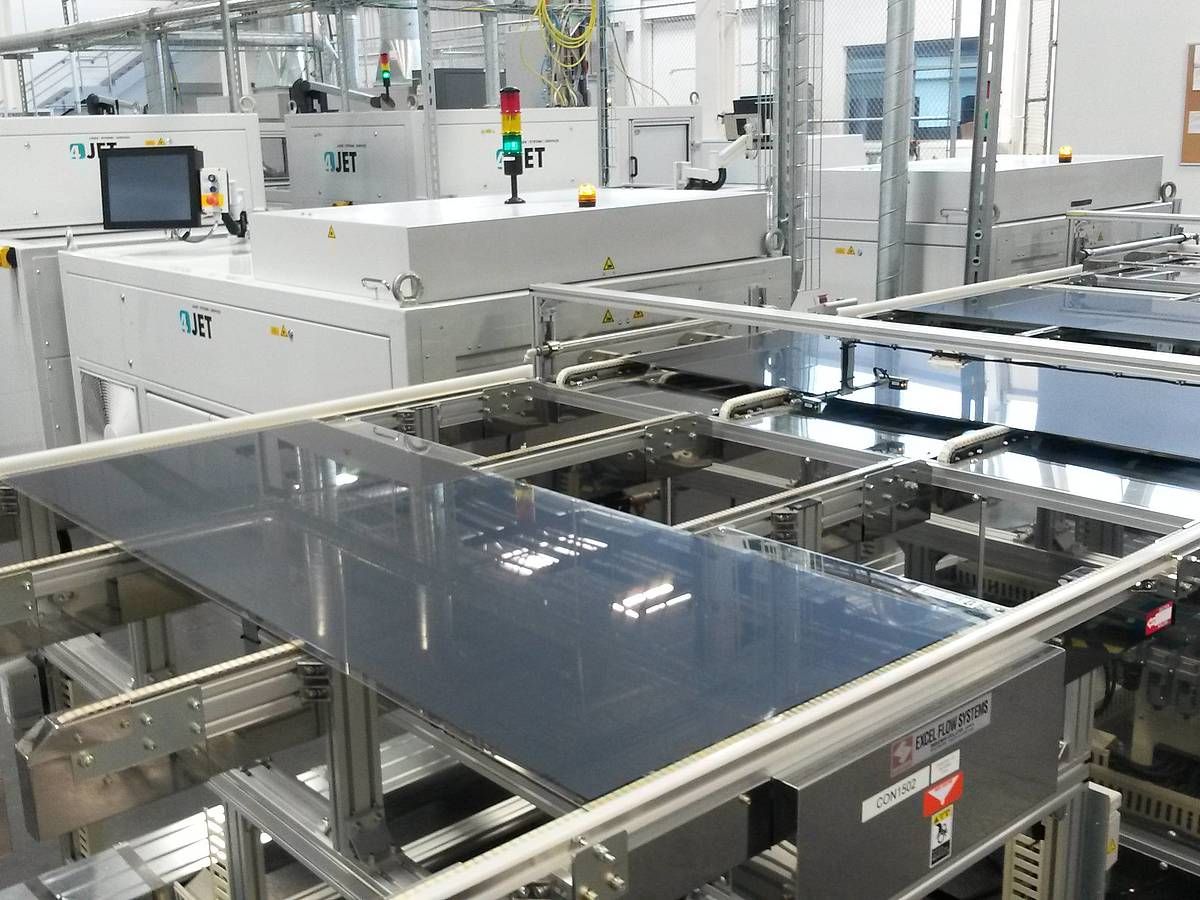
The development of the MPCT system is based on 4JET's many years of experience in the construction of individual machines using the processes of laser edge deletion (LED), molybdenum exposure and laser glass drilling. Within the MPCT, an optimized process sequence consisting of combined processing for laser edge deletion and molybdenum exposure guarantees high-quality solar modules at lowest cycle times. The substrate is processed within three internal stations. Parallel transport from one station to the next ensures a minimum of non-productive time and laser idle time, which is essential for highest throughput. Establishing the junction box connection
Laser glass drilling of two through-holes for the junction box connection is carried out in parallel to the other processes. The substrates are fixed on vacuum bars during processing to compensate for any warpage of the modules, again providing highest quality with a robust design and a large process window for best product quality. The system's robustness, vibration dampening capability and stability, especially in terms of long-term accuracy is achieved by the optimized design. This enables and guarantees a sustainable production of long-life-time CIGS thin-film solar modules.
CIGS BACKEND PROCESSING
The combination of laser and mechanical processing creates reliable long-lifetime CIGS thin-film solar modules, comprising:
Mechanical-tool based molybdenum exposure to provide a clean the surface for the electrical back electrode connection
Laser edge deletion (LED) based on large spot laser ablation to prepare the module for the hermetic sealing
Glass drilling based on laser ablative drilling to provide through-holes to connect the module's front and back electrode with the junction box
MOLYBDENUM REMOVAL TO EXPOSE THE CIGS-MODULE'S BACK ELECTRODE
During the production of CIGS thin-film solar modules the molybdenum layer covering the glass has to be exposed in the area of the photodiode's respectively solar modules back electrode along an area parallel to the long glass edge for the subsequent welding or conductive gluing of conductive ribbons.
This requires the selective removal of the only a few micron thick layer stack of a CIGS absorber and the transparent front electrode (TCO) without damaging the molybdenum layer underneath. This is reliably achieved by mechanical means. CLEAN AND
UNDAMAGED GLASS SURFACE ACHIEVED BY 4JET'S LASER EDGE DELETION PROCESS (LED)
Laser edge deletion (LED) is a contactless process to remove the complete CIGS layer stack from the edges of the solar module to provide an electrical isolation and prepare the glass edge for the hermetic sealing process of the module, without damaging the glass, of course. Edge deletion is achieved by laser ablation, whereby a large laser spot with homogeneous intensity distribution (top-hat profile) structures from the glass side. To achieve the required throughput, the laser ablation head is moved in a continuous motion along the glass edge while a 2D scanner scans the laser spot at very high speed (on-the-fly patterning). By using a glass-side laser ablation process, ablation rates of up to 50 cm²/s and more are possible, which is essential for the required line throughput and means low production costs. Furthermore, the glass-side laser ablation eliminates the risk of melting and thus the formation of short circuits at the edges of the layer stack. Furthermore, the ablation process leaves a clean, undamaged glass surface, which contributes to the production of reliable, durable CIGS modules..
4JET's laser edge deletion (LED) provides:
electrical isolation resistance > 1 GOhm
ablation rates up to 50 cm²/ s and more
highest productivity In contrast to conventional mechanical drilling, laser glass drilling enables a contactless and dry process that minimizes the chipping within the hole.
No reworking of the hole edges is necessary.
This is a necessary prerequisite for high reliability and durability of CIGS solar modules.
Further advantages are not only the high process stability and reproducibility, but also the high flexibility.
In addition to the typical round holes, the software allows the application of different hole geometries.