Industrial Silo Systems
Industrial Silo Systems
Aluminum and stainless steel silo systems; raw material storage, homogenization, level measurement, filtration and automation solutions.
Industrial Silo Systems
Industrial Silo Systems
Safe Raw Material Storage, Homogenization, and Transfer Solutions for the Plastics Industry
Safe storage of raw materials in plastics processing plants, uninterrupted delivery to production lines, and controlled management of different batches are critical for product quality and production continuity.
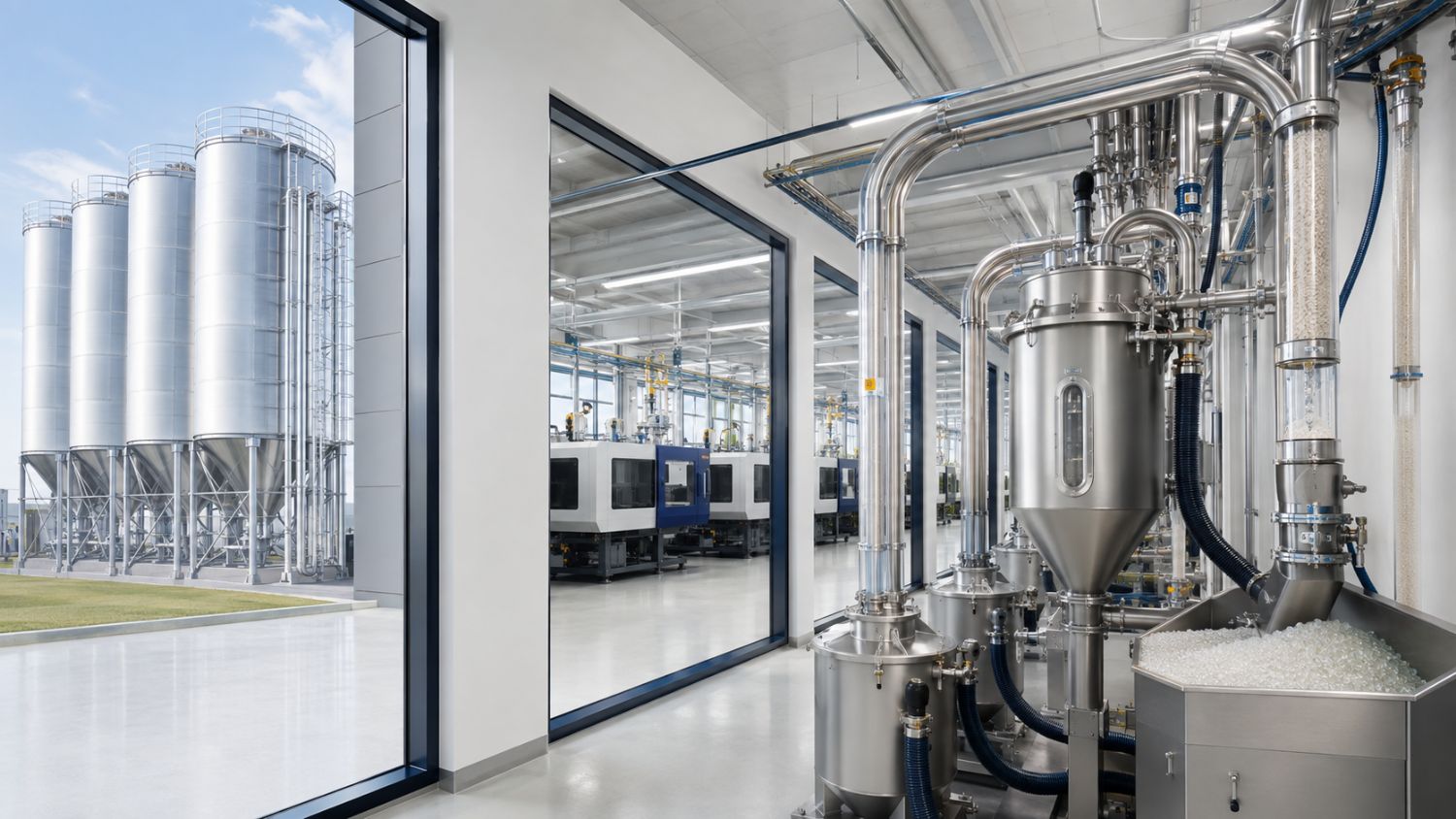
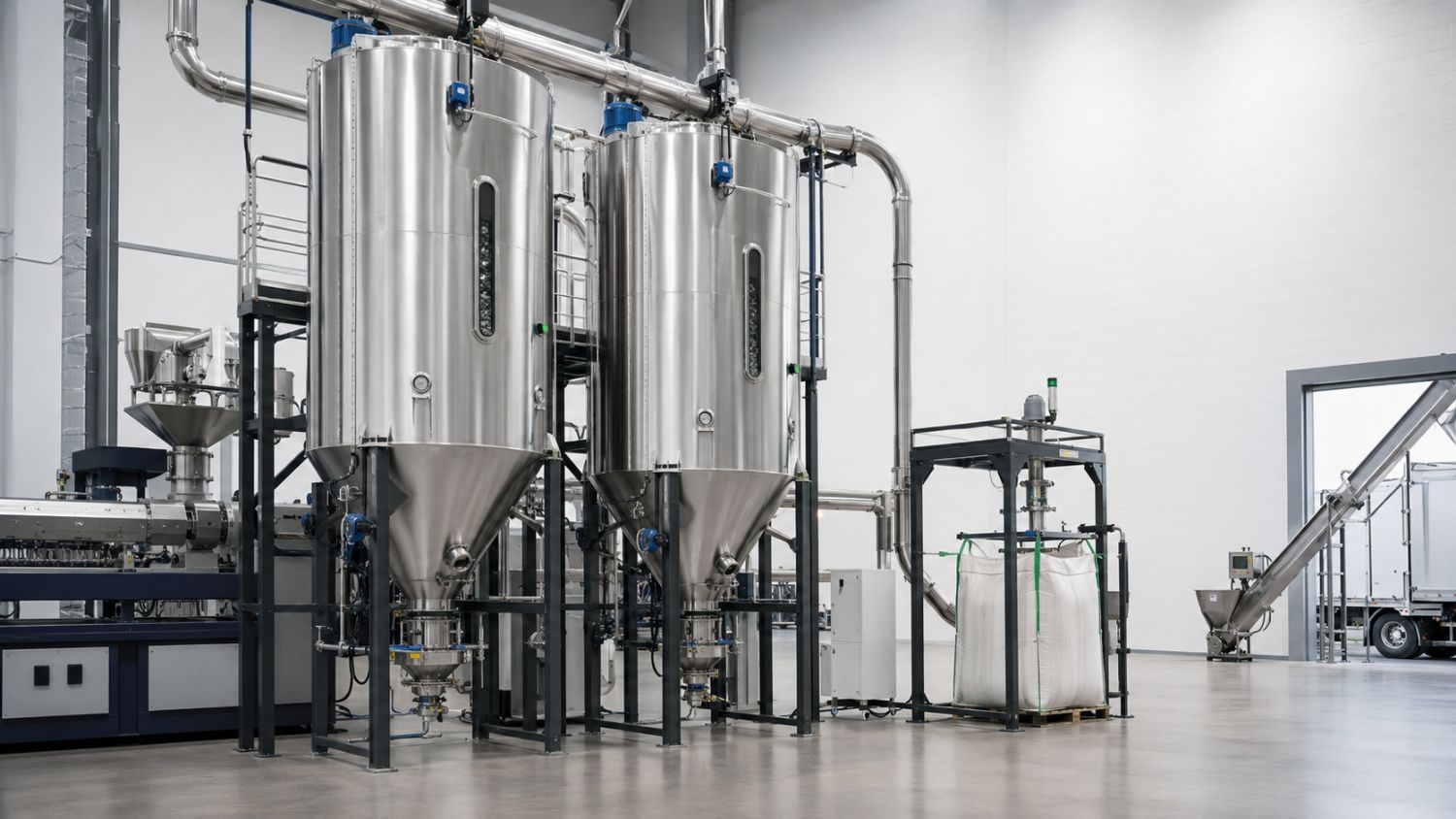
Industrial silo systems are developed for the safe, clean, and economical storage of raw materials in the form of plastic granules, regranules, crushed materials, and powders. These systems can be designed not only as storage units but also as a holistic plant solution with components for filling, level measurement, emptying, filtration, dry air supply, raw material transfer, and automation.
Silo systems, which can be manufactured from aluminum or stainless steel, are designed specifically for each application, taking into account the abrasiveness, flow characteristics, moisture absorption tendency, temperature sensitivity, and flammability of the raw material.
Types of Silos
Indoor Silos
Designed for use within the production area, indoor silos allow for the storage of plastic granules and other bulk raw materials close to the production machinery.
Thanks to different diameter, height, and conical outlet options, solutions can be created to suit the available space and required storage capacity within the facility. Standard indoor silos offer volume options ranging from approximately 1.4 m³ to 19.5 m³.
Outdoor Silos
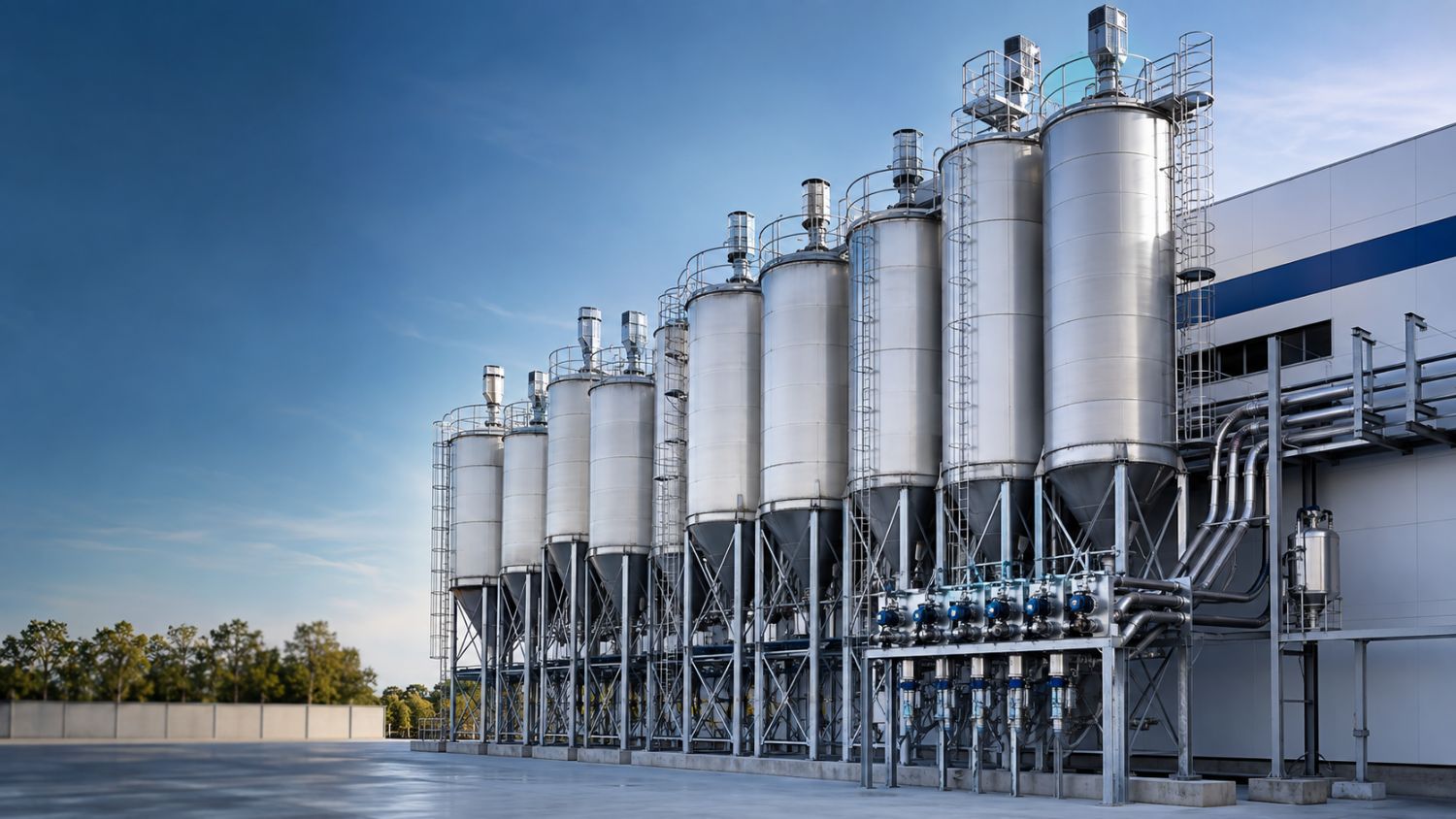
Developed for plastic production facilities that consume high amounts of raw materials, outdoor silos allow for high-capacity storage of raw materials delivered by tankers.
Different models offer volumes ranging from approximately 24 m³ to 318 m³ and diameter options from 2,400 to 4,200 mm. Wind, snow, and earthquake loads specific to the facility's location are considered when designing the silo structure.
Double-Compartment Silos
Double-compartment silos create two separate silo volumes within the same body. This structure is particularly suitable for applications where different raw material batches need to be stored without mixing and batch traceability needs to be maintained.
Raw material delivered by a tanker can be kept in a separate compartment. After the first batch is completely consumed, a manual or automatic transition to the second compartment can be made. This facilitates the application of the FIFO principle in production and the recording of batch changes.
Loading Silos
Loading silos can be used for the controlled loading of granular, regranular, or similar bulk raw materials into tankers, big bags, or other transport equipment. They are particularly preferred in plastic recycling and compounding plants for the storage and preparation of the product for shipment after processing.
Mixing and Homogenization Silos
In plastic recycling and compounding production, differences in color, density, additive ratio, or other physical properties may occur between batches of material produced at different times. Homogenization silos help to make the final product quality more stable.
Different systems can be used depending on the properties of the raw material and the desired mixing quality:
* Screw mixing silos
* Centralblend homogenization silos
* Coneblend homogenization silos
* Channelblend homogenization silos
The appropriate mixing method; The material's particle structure, bulk density, fluidity, process capacity, and the required level of homogeneity are evaluated to determine the appropriate silo geometry.
Silo Geometry Suitable for Raw Material Flow
The silo outlet geometry is important for the safe and orderly discharge of raw materials.
For free-flowing plastic granules, a 60° conical outlet is generally used to achieve bulk flow. In this structure, the material progresses in accordance with the silo entry sequence, and the FIFO principle is supported.
For highly abrasive plastic granules containing glass fiber, a 90° conical structure may be preferred. This design helps reduce friction and abrasion on the silo walls while providing a higher storage volume within the same silo height.
For raw materials with low fluidity or a tendency to bridging or jamming, material analysis should be performed to determine the appropriate silo geometry and discharge equipment.
Central Silo Filling Systems
Silo systems can be offered with central filling stations suitable for pneumatic filling operations from tankers.
Standard solutions; It can be configured to serve 2, 3, 4, 5, or 6 silos arranged in a row. DN100 filling pipes can be manufactured from aluminum or stainless steel. Elbows in the filling lines are offered in stainless steel, with hardened elbow options available for abrasive raw materials.
The following equipment can be supplied within the system:
* Central tanker connection points
* Filling pipes and elbows
* Pipe support and braking structures
* Pipe couplings
* Stress relief
Elements
* Filling line insulation
* Silo filling control valves
* Gaskets and fittings
Silo Level Measurement Systems
Accurate level measurement is crucial for timely raw material supply and preventing silos from running empty. When selecting measurement technology, silo geometry, raw material characteristics, bulk density, and desired measurement accuracy are considered together.
Electromechanical Level Measurement
* Intermittent measurement principle
* Determination of filling volume
* Measurement range up to 30 meters
* Measurement accuracy of up to approximately 2% depending on silo volume
Radar Level Measurement
* Continuous and contactless measurement
* Monitoring of filling volume
* Measurement range up to 120 meters
* Measurement accuracy of up to approximately 2% depending on silo volume
Weighing Systems
* Continuous weight measurement
* Measurement capacity up to 240 tons
* Measurement accuracy of up to approximately 0.5% depending on system weight
Rotary Vane Level Switches
Rotary vane level switches can be used to detect the maximum filling level of the silo and prevent overfilling.
Reliable Silo Emptying Systems
Suction boxes with different numbers of suction points can be used for transferring free-flowing plastic granules from the silo to vacuum conveying systems. These systems can be adapted to common raw material conveying pipe diameters between 38-76.1 mm.
Granule suction bins offer:
* Structure that does not require an additional suction probe
* Modular and combinable design
* Integrated conveying air control
* Stainless steel product contact surfaces
* Empty level sensor connection
* Inspection and cleaning covers accessible from both sides
For raw materials with low fluidity, rotary unloaders, silo activators, and application-specific mechanical unloading equipment can be used. During equipment selection, the hardening behavior of the material depending on the holding time, temperature, and humidity conditions inside the silo are also taken into account.
Silo Filter Systems
Silo filters are required in the storage of raw materials in powder form and in systems where pneumatic filling is performed with tankers. ACHBERG silo filters are designed to filter the conveying air generated during filling.
The filter cartridges are automatically cleaned with compressed air pulses, helping to protect the usable filter surface.
Main features of silo filters:
* 22 m² or 31 m² filter area options
* Antistatic polyester filter cartridges
* Oil and water repellent filter structure
* Stainless steel filter housing
* Compressed air tank and solenoid valves
* Automatic cleaning via pressure switch or external signal
* Protective housing suitable for outdoor use
In applications where the risk of contamination is critical, such as food packaging or medical product manufacturing, the filter can be located next to the silo instead of on the silo roof. Thanks to the ventilation pipe, the filling air is directed to the filter while limiting the contact of the raw material with the outside environment.
Dry Air System to Prevent Condensation
Temperature differences inside the silo can cause condensation and moisture formation on the surface of plastic granules. In cold weather conditions, this moisture can freeze, creating flow problems at the silo outlet or suction box.
The dry air system helps reduce the risk of condensation by providing controlled dry air into the silo. The system can be configured for one, two, or four silo compartments. The amount of dry air and dew point can be adjusted according to the application.
This solution is particularly helpful in:
* Plastic raw materials prone to moisture absorption
* Outdoor silos
* Regions with high temperature variations
* Applications with a risk of freezing during winter months
It helps to increase production reliability.
Foundation and Ready-Made Foundation Plate Solutions
The silo foundation is generally prepared by the customer. Foundation anchors, assembly information, static calculations, and foundation load data can be provided with the system.
Two-part, ready-to-assemble foundation plates can also be used for specific silo models. These plates offer a solution for suitable silo models with diameters of 3.0-4.2 meters and total heights of 10-12.5 meters.
Ready-made foundation plates:
* Can shorten construction time
* Can facilitate on-site application
* Can allow the silo system to be moved to another location in the future
Before silo installation, it is necessary to complete all official permits and on-site inspections in accordance with local regulations.
PLC Control and Plant Automation
The silo system's filling, storage, emptying, and raw material transfer functions can be managed via a PLC-based control system.
The modular software structure and BUS communication reduce cabling requirements. Information from different systems can be centrally collected and displayed on the operator screen.
The silo system can be connected to the plant's central automation or the high-level control unit of the raw material handling system via the PROFINET interface. If required, batch changes, silo fill levels, filling operations, and system statuses can be recorded.
Plastics Industry
Application Areas of Silo Systems
Silo systems can be used in the following processes:
* Plastic injection molding plants
* Extrusion lines
* Plastic compound production
* Masterbatch production
* Plastic recycling and regranulation plants
* PET processing and recycling lines
* Film, sheet, pipe and profile extrusion
* Technical plastic part production
* Food packaging production
* Medical plastic product production
* Centralized raw material handling and distribution systems
Advantages of Silo Systems
* Aluminum or stainless steel construction to suit needs
* Wide capacity options for indoor and outdoor use
* Silo geometry determined according to raw material characteristics
* Solutions suitable for batch separation and FIFO applications
* Homogenization and mixing options
* Reliable level measurement technologies
* Centralized filling and raw material distribution infrastructure
* Dry air solutions against humidity and condensation
* Filter systems suitable for dusty raw materials
* PLC controlled automation and upper system integration
* Project-specific static calculation and engineering
* Mechanical and electrical assembly and commissioning options
The Right Silo How is Capacity Determined?
When determining the required silo capacity, daily raw material consumption, supply time, tanker capacity, raw material bulk density, and the necessary safety stock for the operation should be evaluated together.
For example:
* Daily consumption: 2 tons
* Raw material supply time: 5 days
* Tanker delivery quantity: 25 tons
* Raw material bulk density: 0.6 tons/m³
Under these conditions, the required net volume is calculated to be approximately 58 m³. The appropriate standard silo capacity is determined by considering the operation's production plan and safety margin.