Product Descriptions
Metal Deoxidizers and Surface Brighteners
ACCA Metal Deoxidizers and Surface Brighteners are professional industrial maintenance products developed to remove oxide layers, mineral deposits, tarnishing and heavy surface contamination from aluminium, stainless steel, iron, copper and compatible metal alloys.
Metal surfaces may gradually oxidise or lose their original appearance because of moisture, process water, temperature changes, chemical vapours, production contamination and insufficient maintenance. These deposits are not only an aesthetic concern. Oxidation and surface contamination may make equipment inspection more difficult, conceal the true condition of the substrate and interfere with subsequent maintenance operations.
The ACCA range includes dedicated deoxidizing, descaling, cleaning and brightening products for aluminium, stainless steel, ferrous metals, copper alloys and other industrial surfaces.
Why Metal Oxidation Occurs
Metal surfaces react with oxygen, moisture and different chemicals in their environment. These reactions may produce oxide layers with different appearances and properties.
On iron and carbon steel, oxidation may develop into visible rust. Aluminium may exhibit dull, whitish or dark surface oxidation. Stainless steel can be affected by mineral deposits, process contamination, heat tint, welding residues and unsuitable cleaning procedures.
A correctly selected chemical treatment helps dissolve oxide and mineral layers so that contamination can be removed and the underlying metal surface made visible again.
Applications in Plastics and Rubber Processing
Plastics and rubber production facilities contain moulds, auxiliary equipment, material-handling systems, hoppers, dryers, mixers, pipes and machinery manufactured from different metal alloys. Moisture, process water, heat and chemical residues may cause tarnishing or oxidation on these surfaces.
Following confirmation of product and material compatibility, typical applications include:
* Compatible metal surfaces on plastics and rubber machinery
* Stainless-steel hoppers and material-handling equipment
* Stainless-steel pipes and connections
* Aluminium machine components and guards
* Metal workbenches
* Stainless-steel tanks and vessels
* Compatible heat-affected welding areas
* Mould-handling and clamping equipment
* Metal maintenance tools and assembly fixtures
* Oxidised iron, steel and cast-iron parts
* Components manufactured from copper, brass and bronze
* Parts requiring surface inspection before maintenance
Detailed compatibility testing and manufacturer approval are required before treating precision mould cavities, highly polished surfaces, coated moulds or dimensionally critical components.
What Is Chemical Brightening?
Chemical surface brightening differs from mechanical polishing. Chemical brighteners dissolve oxide films, mineral marks and surface contamination so that the metal can regain a cleaner and brighter appearance.
Chemical brightening does not:
* Remove deep scratches
* Repair pitting or metal loss
* Restore a damaged coating
* Correct dimensional damage
* Fully replace mechanical polishing where an engineered surface finish is required
Its purpose is to remove compatible oxide and contamination layers in a controlled manner and reveal the natural appearance of the metal surface.
Main Benefits
When the correct ACCA product and application method are used, potential benefits include:
* Removal of oxide layers and surface tarnishing
* Cleaning of mineral deposits and heavy contamination
* Improved appearance of aluminium and stainless-steel surfaces
* Removal of compatible post-welding discolouration
* Easier maintenance of stainless-steel equipment
* Preparation of metal surfaces for inspection or subsequent processes
* Chemical action in areas that are difficult to clean mechanically
* Dedicated product options for different metals and alloys
* Support for restoration of tanks, machinery and process equipment
* Integration into preventive maintenance programmes
Results depend on the metal, type of oxide, surface treatment, concentration, temperature and contact time.
Selecting a Product According to the Metal
Different metals have different levels of chemical resistance. A product developed for aluminium may perform differently on stainless steel, while a strong stainless-steel treatment may be unsuitable for aluminium or galvanised surfaces.
The following information should be established before selecting a product:
* Base metal and alloy
* Presence of coating, plating or anodising
* Type of oxide or mineral layer
* Whether the surface is matt, polished, brushed or mirror-finished
* Dimensional sensitivity of the part
* Application method and operating temperature
* Rinsing, neutralisation and subsequent protection requirements
If the metal cannot be positively identified, treatment should not proceed until a controlled compatibility test has been completed.
Featured ACCA Products
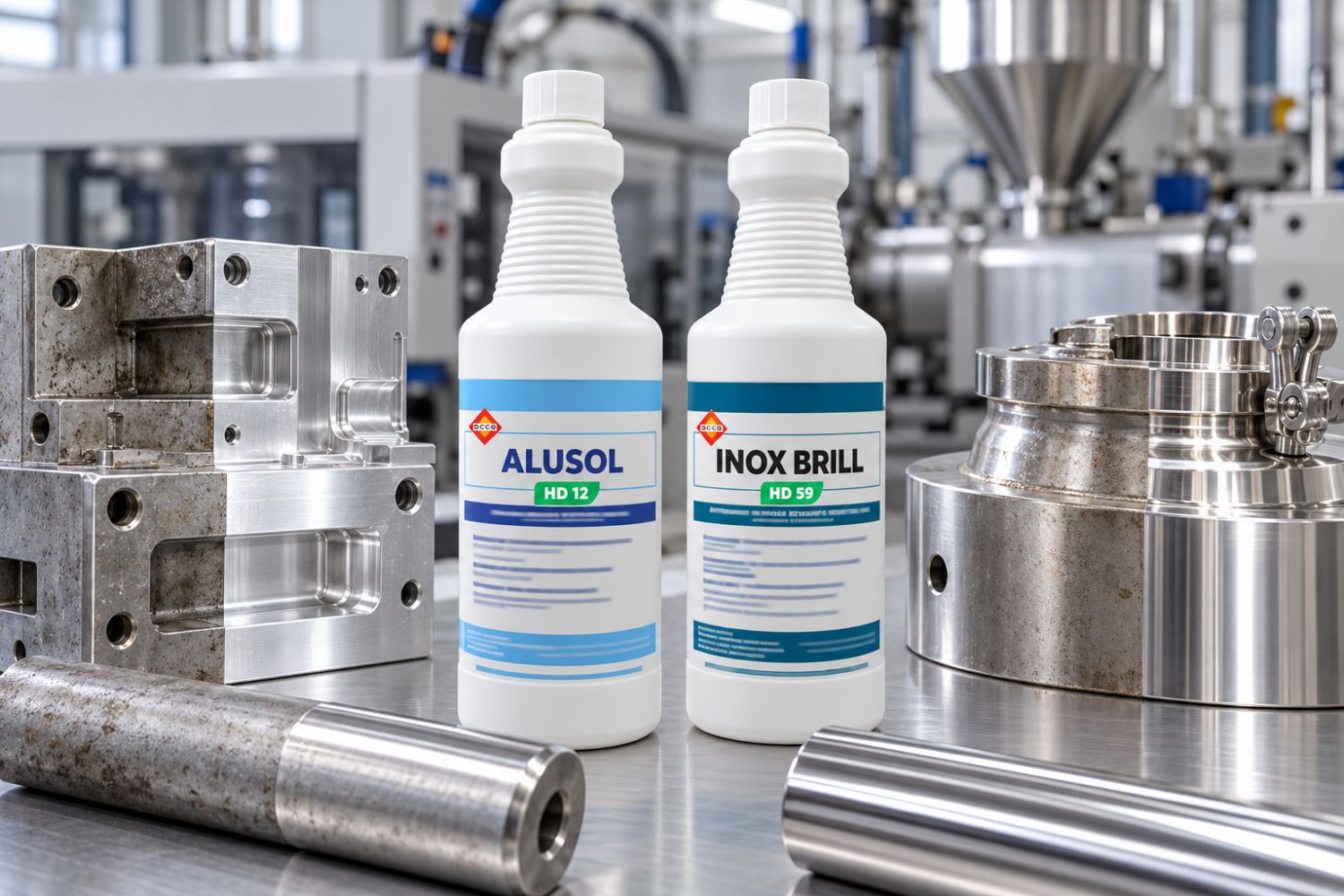
ALUSOL HD 12
A multifunctional surface-cleaning product developed to remove scale, dirt and oxide deposits from aluminium and its alloys. It combines descaling, cleaning and deoxidizing actions.
It may be considered for aluminium parts and compatible machine components. By removing contamination, limescale and oxidation, it helps restore a cleaner and brighter appearance.
Compatibility must be confirmed before application to anodised, painted or coated aluminium.
ALUSOL HD 12 FORTE
A strong descaling and deoxidizing product developed for aluminium and stainless steel. It provides an effective solution for cleaning and chemically pickling aluminium surfaces.
ACCA also identifies it for removing black welding residues from stainless steel. Because of its strong and rapid action, concentration, contact time and surface compatibility must be carefully controlled.
BRILLINOX HD 700
A descaling and brightening product developed for oxidation, scale and heavy contamination on stainless-steel surfaces.
It helps remove oxide and dirt, leaving the stainless-steel surface cleaner and brighter. Its formulation contains inhibited acids intended to support controlled treatment of compatible surfaces.
It may be considered for periodic maintenance of stainless-steel machine components, tanks, vessels and suitable production equipment.
INOX BRILL HD 59
A descaling, cleaning and brightening product developed for stainless steel. It removes heavy contamination and compatible deposits, helping restore a clean and bright surface appearance.
It is particularly suitable for surface maintenance of stainless-steel machinery, tanks, vessels and process equipment. The treated surface should be rinsed according to the product instructions.
NOXIL HD 32
A multifunctional metal-maintenance product combining degreasing, deoxidizing, descaling and passivating actions.
ACCA describes it for use on iron, steel, cast iron, copper, brass, bronze, lead, zinc, aluminium and compatible alloys. It can provide a practical option for workshops maintaining components made from several different metals.
Concentration and contact time may vary between metals and must be verified in the technical documentation.
QUIVER HD 46
A descaling and brightening product for mineral deposits, tarnishing and oxidation on copper and copper alloys. It may be considered for compatible copper, brass and bronze components.
QUIVER HD 46/B
A specialised deoxidizer and brightener for silver surfaces. Suitability must be confirmed before it is used on industrial electrical contacts or sensitive components containing silver.
Application Method
Depending on the selected product and component, application methods may include immersion, brushing, wiping, spraying or controlled local treatment.
A general application sequence may include:
1. Identify the metal and alloy.
2. Remove oil and loose contamination using a suitable preliminary cleaner.
3. Test the product on a small, inconspicuous area.
4. Prepare the concentration specified in the Technical Data Sheet.
5. Apply at the stated temperature and contact time.
6. Monitor the surface and reaction at regular intervals.
7. Stop the treatment once the required cleaning level has been achieved.
8. Rinse or neutralise according to the product instructions.
9. Dry the part completely.
10. Apply a suitable corrosion-protection product if required.
The product should not be allowed to dry uncontrollably on the surface. Excessive contact time may cause changes in colour, texture or surface finish.
Use on Mould Surfaces
Mould steels differ from standard machine components in hardness, alloy composition and surface treatment. Mirror-polished cavities, chrome or nickel plating, nitrided surfaces, PVD coatings and textured areas may be affected by chemical treatments.
For this reason:
* Do not apply the product indiscriminately to mould cavities.
* Identify the mould steel and surface treatment.
* Perform a small compatibility test.
* Begin with a short contact time.
* Rinse and dry the surface thoroughly after treatment.
* Apply an appropriate mould protector where required.
For routine mould-cavity cleaning, a dedicated mould cleaner compatible with the surface may be more appropriate than a strong acidic deoxidizer.
Safety and Environmental Precautions
Metal deoxidizers and surface brighteners may be acidic. The current Technical Data Sheet and Safety Data Sheet must be reviewed before use.
During application:
* Wear chemical-resistant gloves, eye protection and appropriate protective clothing.
* Provide adequate ventilation.
* Never mix the product with hypochlorite, chlorine-containing cleaners, alkaline products or other chemicals.
* Do not apply to hot or pressurised equipment.
* Avoid inhalation of spray or vapour.
* Collect spent solution in suitable containers.
* Manage liquid waste according to applicable regulations.
* Rinse and dry the treated surface according to the product instructions.