Product Descriptions
Lime and Mineral Deposit Removers
ACCA Lime and Mineral Deposit Removers are professional chemical products developed for the controlled removal of limescale, deposits and mineral build-up from mould cooling channels, pipes, heat exchangers, temperature-control systems and compatible industrial equipment.
Calcium, magnesium and other minerals present in process water may gradually form hard deposits on internal surfaces. Mineral build-up can become more pronounced in systems exposed to changing temperatures, continuous water circulation or insufficiently controlled water quality.
Scale inside mould channels and heat exchangers may restrict the available flow area and interfere with heat transfer between the metal surface and circulating water. Correctly planned chemical cleaning helps keep channels open, supports heat transfer and contributes to stable cooling-system operation.
Scale Problems in Plastics and Rubber Processing
Accurate temperature control is important in injection moulding, extrusion, blow moulding, thermoforming and rubber-processing operations. Moulds, extrusion lines and auxiliary equipment commonly use water-based cooling or temperature-control circuits.
Mineral deposits in mould cooling channels may contribute to:
* Reduced cooling-water flow
* Temperature differences between mould zones
* Longer cooling times
* Unstable production cycles
* Increased risk of part deformation and dimensional variation
* Reduced performance of temperature-control units and heat exchangers
* Increased load on pumps and connecting components
* More frequent maintenance and a greater risk of unplanned stoppages
Descaling alone cannot eliminate every process problem. However, it is an important part of preventive maintenance when restrictions in flow and heat transfer are caused by mineral deposits.
Main Application Areas
Subject to product specifications and confirmed material compatibility, ACCA lime and mineral deposit removers may be used for:
* Cooling channels in plastic injection moulds
* Temperature-control circuits in rubber moulds
* Compatible cooling systems on extrusion lines
* Industrial heat exchangers
* Pipes and connecting elements
* Suitable water circuits in temperature-control units
* Chillers and auxiliary cooling equipment
* Water heaters
* Boilers and radiator systems
* Compatible metal parts affected by scale
* Equipment carrying cement, mortar or mineral-based residues
* Vertical surfaces affected by scale and mineral deposits
Product selection should consider not only the amount of contamination but also the substrate, system volume, operating temperature, circulation method and disposal requirements for the spent cleaning solution.
Potential Benefits of Descaling
Chemical cleaning with the correct product and application method may provide the following benefits:
* Dissolution of limescale and mineral deposits
* Cleaning of restricted water channels
* Support for cooling-water circulation
* Cleaning of heat-transfer surfaces
* Contribution to more consistent mould temperature control
* Easier maintenance of cooling systems
* Removal of deposits from heat exchangers and pipes
* Preparation of equipment for inspection and subsequent maintenance
* Access to internal passages that are difficult to clean mechanically
* Contribution to reducing deposit-related maintenance interruptions
Actual results depend on the composition and thickness of the deposits, system design, substrate, concentration, temperature and contact time.
Selecting the Correct Product
Inhibited descalers should be considered for mould channels, pipes and heat exchangers where controlled metal protection is required during the cleaning process. Gel formulations can be selected for vertical surfaces where extended surface contact is needed.
Stronger formulations may be required for heavy cement, mortar or lime deposits. Closed-circuit cleaning may benefit from products designed for circulation and from formulations that allow the cleaning process to be monitored.
Aluminium, copper, brass, galvanised metal, stainless steel, carbon steel, seals, hoses, plastics and elastomers have different levels of resistance to acidic products. All materials in the system must therefore be identified and product compatibility confirmed before cleaning begins.
Featured ACCA Products
HD A 10
A powerful acidic descaler developed for removing cement, concrete, lime and similar mineral residues. Its formulation contains corrosion inhibitors and surfactants.
It may be considered for concrete mixers, formwork, tools and compatible industrial equipment affected by mineral residues. In plastics-processing facilities, it provides an option for heavy mineral contamination on suitable auxiliary equipment and surfaces.
HD A 10 GEL
An acidic gel cleaner developed for removing lime, concrete and cement deposits. Its gel consistency helps the product remain in contact with vertical surfaces for longer.
It is suitable for controlled treatment of compatible vertical machine and equipment surfaces where a liquid cleaner would run off too quickly.
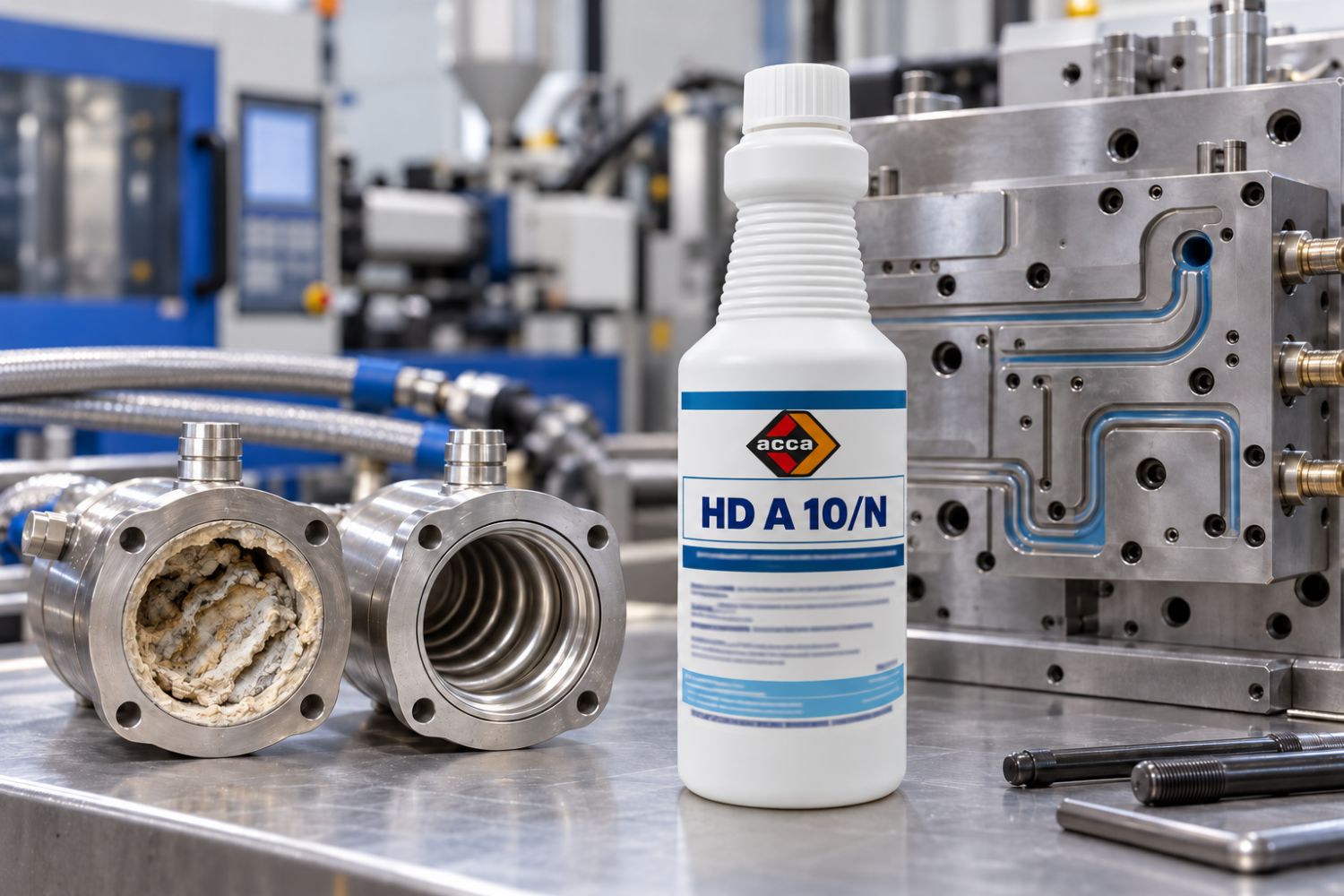
HD A 10/N
An inhibited descaler developed to dissolve limescale deposits. It is offered for applications including boilers, pipes, radiators, water heaters and heat exchangers.
Following confirmation of material compatibility, it may also be considered for mould cooling channels and closed or semi-closed temperature-control circuits. Its inhibited formulation helps protect compatible metal surfaces during treatment.
HD A 10/N ECO
An inhibited and biodegradable product option for dissolving limescale deposits. ACCA describes the product as free from phosphorus and nitrogen and as biodegradable according to OECD 301F testing.
It may be considered for industrial maintenance operations in which environmental criteria and waste management are important factors in product selection. The spent cleaning solution must still be handled according to applicable regulations and the facility's waste-management procedures.
HD A 10/N FDA
An inhibited descaler developed for industrial applications in the food sector. It can be used on suitable equipment and surfaces requiring removal of limescale deposits.
The "FDA" designation should not be interpreted as unconditional approval for direct food contact. Application, rinsing and compliance requirements must be confirmed in the current technical documentation.
HD A 10/N POLVERE
A powdered inhibited descaler developed for removing limescale deposits. It contains surfactants and corrosion inhibitors.
Preparation, dosing and application of the powder must follow the mixing and safety instructions stated in the current Technical Data Sheet.
HD A 10/N VRI
An inhibited descaler with a colour-change indicator for limescale deposits in closed circuits. The indicator helps operators monitor the condition of the cleaning solution and the progress of the treatment.
It may be considered for professional cleaning of mould cooling circuits, heat exchangers and other compatible closed systems.
Application Method
Depending on the equipment and selected product, descaling may be performed by circulation, immersion, spraying, brushing or local gel application.
A typical closed-circuit procedure may include:
1. Shut down, isolate, cool and depressurise the system.
2. Determine the system volume and identify all materials in the circuit.
3. Remove loose deposits mechanically where practical.
4. Prepare the selected product at the concentration stated in its Technical Data Sheet.
5. Circulate the cleaning solution for the specified time and at the specified temperature.
6. Monitor the cleaning process at appropriate intervals.
7. Drain and, where required, neutralise the spent solution.
8. Rinse the circuit with clean water until suitable outlet conditions are achieved.
9. Inspect connections, sealing components and water flow.
10. Recommission the system with water of the required quality.
Concentration, temperature and contact time vary by product and application. A single standard cleaning recipe should therefore not be applied to every system.
Safety and Material Compatibility
Descaling products are generally acidic. The current Technical Data Sheet and Safety Data Sheet must be reviewed before use.
During application:
* Wear chemical-resistant gloves, eye protection and any other required protective equipment.
* Provide adequate workplace ventilation.
* Never mix the product with hypochlorite, chlorine-containing cleaners or other chemicals.
* Perform dilution and preparation only according to the manufacturer's instructions.
* Do not clean a system while it is hot or pressurised.
* Confirm compatibility with sensitive metals, seals, plastics and elastomers.
* Do not discharge spent solution directly into the drainage system; handle it according to applicable regulations.
* Rinse the system thoroughly after cleaning.