Product Descriptions
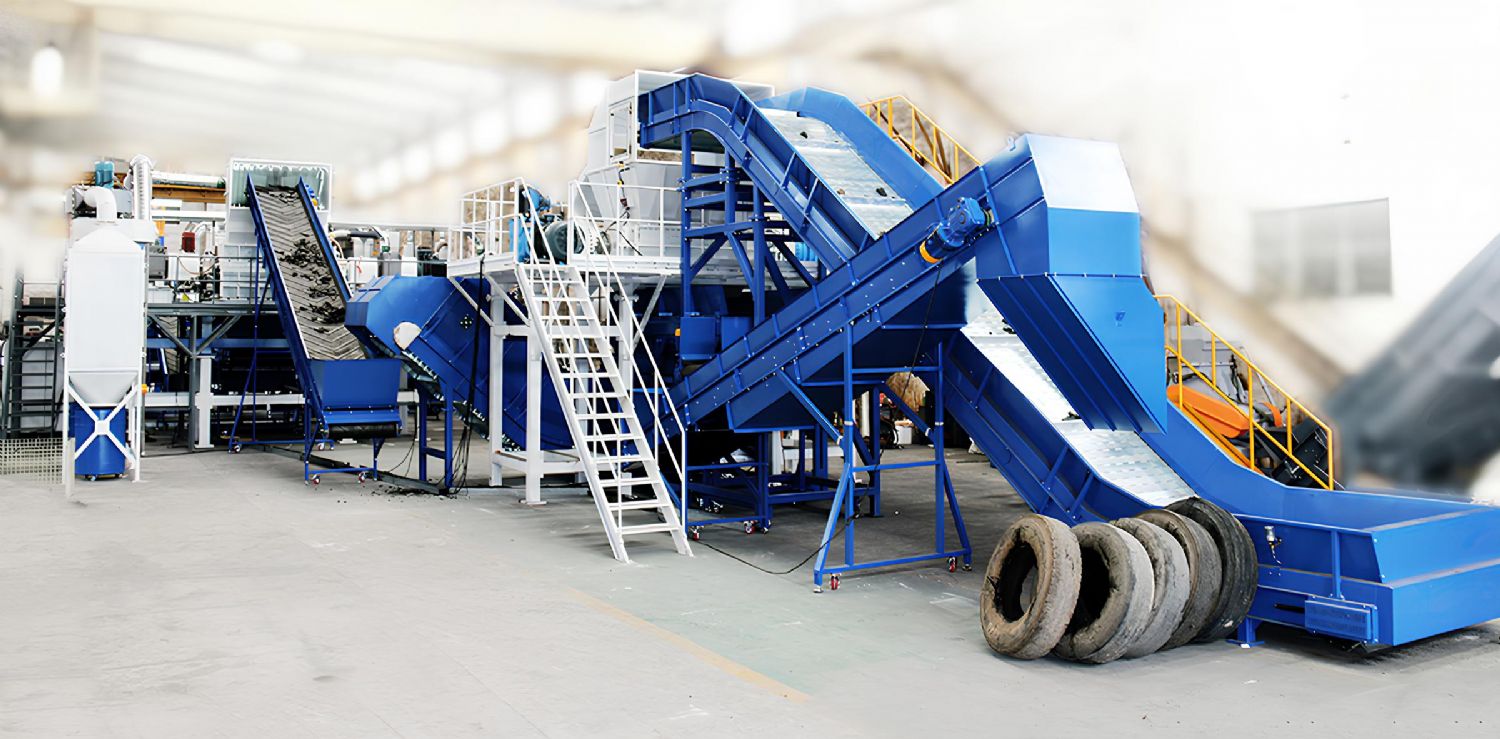
3E Tire Recycling Line - Industrial Waste Tire Recycling System
The recycling of used passenger car, truck, and heavy-duty tires is one of the most important areas of the modern recycling industry. Millions of tons of waste tires are generated worldwide every year, and recovering these materials without harming the environment has become increasingly important.
The Tire Recycling Line developed by 3E Machinery is a high-capacity industrial recycling system designed to process waste tires through mechanical shredding and separation processes to produce rubber granules and rubber powder.
Through this system, waste tires can be converted into the following valuable materials:
rubber granules
rubber powder
steel wire
textile fiber
These recovered materials can be used in a wide range of industries such as asphalt production, sports field surfaces, insulation materials, rubber product manufacturing, and energy recovery applications.
Tire Recycling Process Principle
Waste tire recycling lines typically operate based on a multi-stage mechanical shredding and separation process.
During the recycling process, tires pass through the following stages:
primary shredding
secondary crushing
metal separation
fiber separation
rubber granule production
rubber powder production
Through this multi-stage process, tires are completely broken down and separated into their individual components.
Types of Tires That Can Be Processed
The 3E tire recycling line has a wide processing range and can handle various types of tires.
Processable tire types include:
passenger car tires
truck tires
tractor tires
OTR (off-the-road) tires
construction machinery tires
The system is designed to process tires with diameters ranging from approximately 400 mm to 3000 mm.
This wide range allows the system to recycle both passenger vehicle tires and large industrial tires.
System Capacity
The 3E Tire Recycling Line can be manufactured in different capacity configurations.
Typical production capacity:
500 kg/hour - 10,000 kg/hour
The exact capacity depends on machine size, rotor design, and the desired final product size.
High-capacity systems are particularly suitable for:
municipal recycling facilities
industrial tire recycling plants
RDF fuel production plants
Tire Recycling Line System Components
A waste tire recycling line consists of multiple machines and equipment working together.
The main equipment includes:
Tire Debeader
This machine is used to remove the steel bead wire located inside the tire.
Advantages include:
protection of shredder blades
more stable shredding performance
extended equipment lifespan
Primary Tire Shredder
The first shredding stage is carried out in the primary shredder.
The most commonly used machine type is a double shaft shredder.
Technical characteristics include:
low speed operation
high torque output
ability to process large materials
At this stage, tires are shredded into pieces approximately 50 - 150 mm in size.
Secondary Crusher / Granulator
After primary shredding, the tire pieces are sent to the granulator.
During this stage:
the material size is further reduced
rubber granules are produced
steel wires begin to separate from the rubber
Magnetic Separator
Magnetic separators are used to remove steel wire from the shredded rubber.
This process allows:
recovery of steel scrap
improvement of rubber granule purity
Fiber Separator
Textile fibers present in automobile tires are separated at this stage.
Fiber separation helps achieve:
cleaner rubber granules
higher final product quality
Vibrating Screen
The vibrating screen system classifies rubber granules by size.
This allows the production of rubber granules in different particle sizes.
Rubber Powder Mill
In the final stage, rubber granules can be further processed into fine rubber powder.
Final Product Sizes
The system can produce rubber products in different particle sizes.
Typical product sizes include:
5 - 20 mm rubber granules
1 - 5 mm rubber granules
0.5 - 1 mm rubber powder
These materials are widely used in various industrial applications.
Recovered Products
The waste tire recycling line produces several valuable recycled materials.
Rubber Granules
Applications include:
sports field surfaces
playground safety flooring
asphalt additives
rubber product manufacturing
Rubber Powder
Applications include:
asphalt modification
automotive components
insulation materials
Steel Wire
Steel wire recovered from tires can be sold as scrap metal for recycling.
Textile Fiber
Textile fibers can be used for energy recovery or as alternative fuel material.
System Advantages
The 3E tire recycling line offers several technical advantages.
High Capacity
Production capacity can reach up to 10 tons per hour.
Automatic Operation
The entire system can be controlled through a PLC-based control system.
High Purity Output
Metal and fiber separation ensures high-quality rubber granules.
Energy Efficiency
Optimized rotor and blade design reduces energy consumption.
Modular Design
The system can be easily expanded or configured for different capacities and applications.
Application Areas
Tire recycling systems are used in many different industries.
Major application areas include:
rubber granule production plants
RDF fuel production facilities
asphalt additive production
sports field surface manufacturing
automotive industry
plastic and rubber compounding
Importance in Industrial Recycling
Waste tires can remain in the environment for extremely long periods without decomposing. Therefore, recycling systems play a critical role in environmental sustainability.
Industrial tire recycling systems help to:
reduce landfill requirements
prevent environmental pollution
recover valuable raw materials
create economic value from waste materials