Product Descriptions
Stainless Steel Pickling and Passivation Products
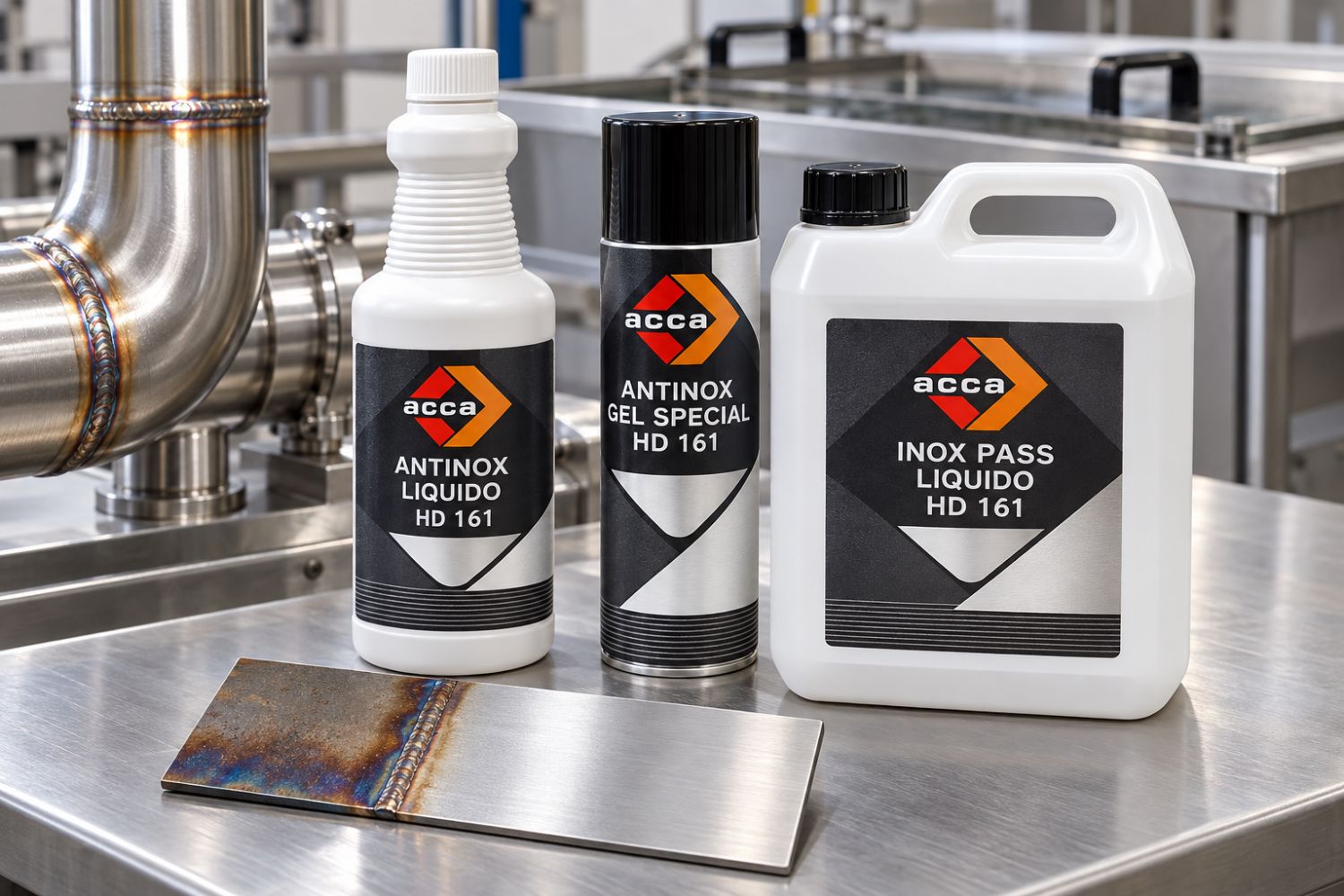
ACCA stainless steel pickling and passivation products are developed to remove oxide layers, heat tint and surface contamination generated by welding, heat treatment and manufacturing. Liquid, gel and immersion products help clean stainless steel surfaces and support the restoration of their natural protective passive layer.
The corrosion resistance of stainless steel is provided by a thin protective chromium oxide layer that forms naturally on its surface. Welding, grinding, cutting, bending, heat treatment and mechanical fabrication can damage this layer. Heat tint, oxides, free iron particles and other surface contaminants around welded areas can negatively affect both the appearance and corrosion resistance of stainless steel.
Pickling chemically removes oxide layers and metallic contamination created by welding and heat treatment. It helps restore a clean and uniform stainless steel surface.
Passivation supports the reformation of the protective passive layer after pickling and rinsing. It therefore contributes to maintaining the resistance of the surface against environmental exposure and corrosion.
The ACCA range includes liquid products for immersion pickling of small components, gel formulations for large and vertical surfaces, a highly buffered gel for localised weld cleaning and a nitric-acid-free passivating liquid for 300-series stainless steels.
Pickling and passivation are not interchangeable processes. Pickling removes oxides and welding residues, while passivation supports the restoration of the protective characteristics of the cleaned surface. Depending on the application requirements, the two processes can be performed consecutively.
Products
ANTINOX LIQUIDO HD 161
A liquid product developed for post-weld pickling of stainless steel components. It is particularly suitable for immersion treatment of small parts. Full immersion allows the product to reach complex geometries and areas that may be difficult to clean manually.
The ACCA catalogue indicates use at a 50 percent dilution and an approximate contact time of 5 to 10 minutes. The concentration and contact time should be verified according to the technical data sheet, stainless steel grade, oxide severity, processing temperature and surface condition.
Main characteristics:
- Liquid pickling product for stainless steel
- Helps remove post-weld oxides and heat tint
- Suitable for immersion treatment of small components
- Can reach the complete surface of complex-shaped parts
- Suitable for batch treatment
- Prepares the surface for subsequent passivation
ANTINOX GEL HD 161
A gel product developed for post-weld pickling of medium and large stainless steel surfaces and machinery. It is applied directly to the required area using a brush or spatula.
Its gel consistency helps it remain on vertical surfaces and limits downward flow. This enables controlled treatment of weld seams, tanks, pipes, machinery bodies and large components that cannot be immersed.
Main characteristics:
- Gel formulation for stainless steel weld areas
- Suitable for medium and large surfaces
- Local application by brush or spatula
- Controlled contact on vertical surfaces
- Helps remove heat tint and oxide layers
- Does not require an immersion tank
ANTINOX GEL SPECIAL HD 161
A highly buffered special gel developed for localised post-weld pickling of stainless steel. It is applied only to the area requiring treatment and provides controlled local weld cleaning.
The ACCA catalogue describes it as a highly buffered safety pickling gel suitable for different types of steel. Pickling chemicals nevertheless require strict compliance with all precautions specified in the safety data sheet.
Main characteristics:
- Localised post-weld pickling
- Controlled application by local contact
- Highly buffered gel formulation
- Suitable for vertical and difficult-to-reach areas
- Helps limit contact with surrounding surfaces
- Suitable for small weld areas and maintenance applications
INOX PASS LIQUIDO HD 161
A liquid passivating and decontaminating product developed for 300-series stainless steels. It is used by immersion and supports the restoration of the natural passive layer following pickling or mechanical treatment.
The formulation is free from nitric acid. The ACCA catalogue specifies a minimum contact time of 2 hours. The actual treatment time should be determined according to the technical data sheet, steel grade, surface condition, bath temperature and process requirements.
Main characteristics:
- Passivation of 300-series stainless steels
- Applied by immersion
- Supports restoration of the natural protective passive layer
- Helps reduce the risk associated with free iron and surface contamination
- Nitric-acid-free formulation
- Complements the pickling process
Difference Between Pickling and Passivation
Pickling is used to remove oxides, heat tint and metallic contamination generated by welding and heat treatment. A controlled amount of material may be removed from the stainless steel surface during the process.
Passivation supports the formation of a protective chromium oxide layer on the cleaned surface. It does not replace pickling when heavy oxides or significant weld heat tint must be removed.
Where a surface has heavy post-weld discolouration or oxide deposits, pickling should generally be followed by thorough rinsing and, where required, passivation.
Recommended General Process Sequence
1. Pre-cleaning
Oil, grease, fingerprints, machining fluids and other organic contamination should be removed using a suitable cleaner. An oily surface can prevent uniform contact between the pickling product and the metal.
2. Rinsing
The surface should be rinsed with clean water to remove the pre-cleaning product and dissolved contamination.
3. Pickling
ANTINOX LIQUIDO, ANTINOX GEL or ANTINOX GEL SPECIAL is selected according to the size and geometry of the component. The product should only be used within the concentration, temperature and contact-time limits stated in its technical documentation.
4. Rinsing After Pickling
Chemical residues must be completely removed from the surface. Water of a suitable quality should be used according to the requirements of the application.
5. Passivation
When required, 300-series stainless steel components are passivated using INOX PASS LIQUIDO. Full and uniform contact between the product and the surface should be ensured.
6. Final Rinsing and Drying
After passivation, the component should be thoroughly rinsed and dried under clean conditions. Recontamination by carbon-steel tools or iron-containing materials should be prevented.
Main Application Areas
- Cleaning stainless steel weld seams
- Removal of post-weld heat tint
- Stainless steel tanks and vessels
- Pipes and pipe fittings
- Food and beverage processing equipment
- Chemical and pharmaceutical equipment
- Stainless steel machinery bodies
- Heat exchangers and process equipment
- Stainless steel railings and structures
- Welded sheets and profiles
- Immersion pickling of small components
- Gel pickling of large and vertical surfaces
- Surface restoration after fabrication and maintenance
- Surface preparation before passivation
- Passivation of 300-series stainless steels
Key Benefits
- Helps remove heat tint and oxide layers
- Supports a uniform stainless steel surface appearance
- Contributes to the removal of contaminants that may impair corrosion resistance
- Provides liquid and gel solutions for different component sizes
- Enables controlled gel application on vertical surfaces
- Allows immersion treatment of small and complex-shaped components
- Provides local application for individual weld areas
- Supports restoration of the natural passive layer after pickling
- Offers a nitric-acid-free passivation option
- Helps prepare a clean surface for inspection, assembly and service
Product Selection
ANTINOX LIQUIDO HD 161 can be selected for small, complex-shaped stainless steel components suitable for full immersion.
ANTINOX GEL HD 161 provides more controlled application on tanks, machinery bodies, pipes, sheets and other large or vertical surfaces.
Where only a weld seam or limited area requires pickling, highly buffered ANTINOX GEL SPECIAL HD 161 can be considered.
After pickling and rinsing, INOX PASS LIQUIDO HD 161 can be used to support restoration of the passive layer on 300-series stainless steel.
The following factors should be considered during selection:
- Stainless steel grade and alloy group
- Severity of oxide deposits and heat tint
- Component size and geometry
- Horizontal or vertical surface
- Local application or complete immersion
- Production volume and available treatment time
- Required surface appearance
- Final service environment and corrosion risk
- Applicable industry standards and customer specifications
Application and Safety Statement
Pickling products can contain strongly acidic chemicals. Application should only be carried out by trained personnel in a properly ventilated area using the personal protective equipment specified in the current safety data sheet.
Chemical-resistant gloves, protective clothing, face and eye protection, and suitable respiratory protection may be required. Products must not be mixed with other chemicals, and appropriate emergency equipment must be available in the treatment area.
Excessive contact time may cause over-etching or changes in surface appearance. A preliminary test on a small area is recommended. Process parameters should be established according to the technical data sheet, and the surface must be thoroughly rinsed after treatment.