Product Descriptions
Paint, Adhesive and Ink Removers
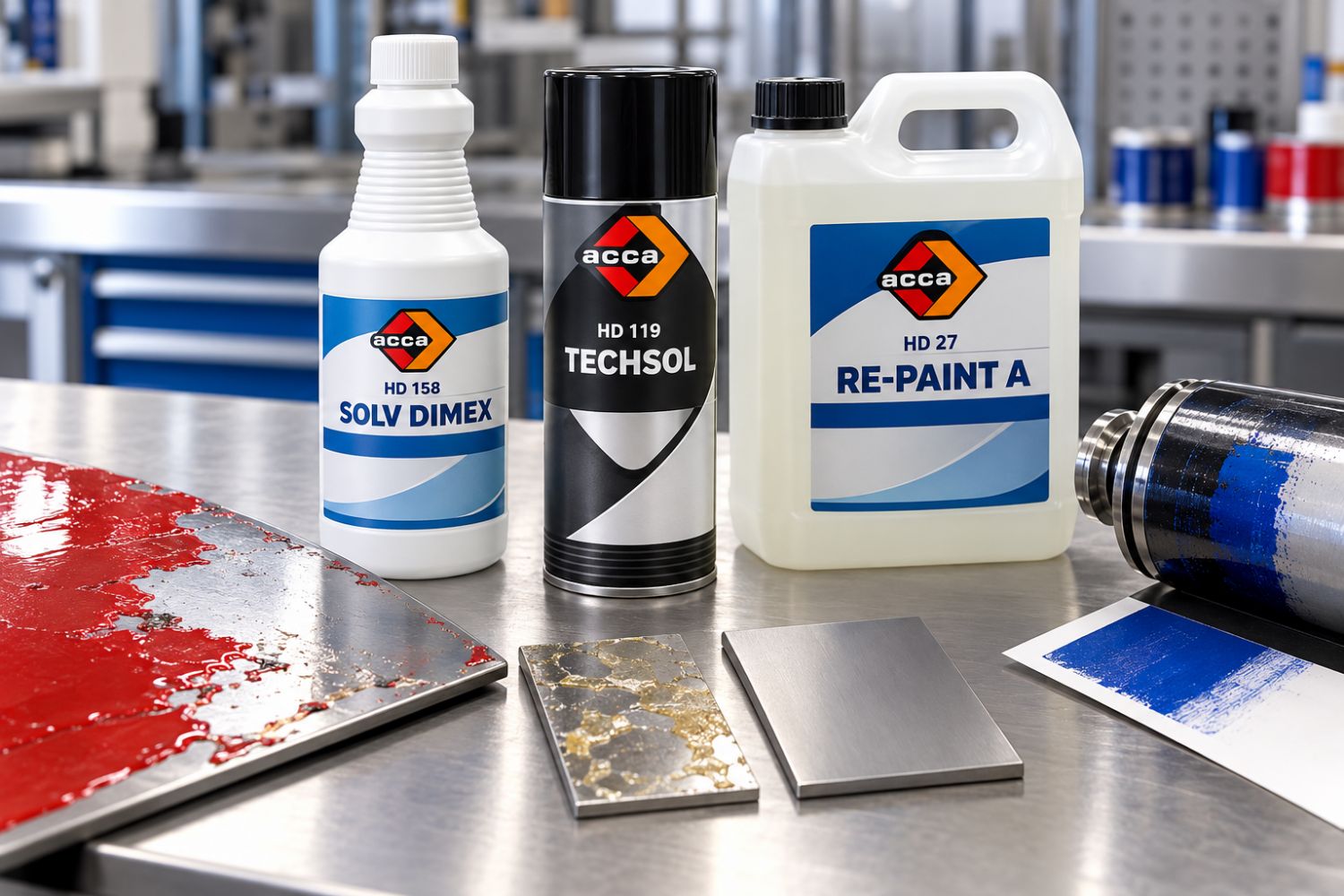
ACCA paint, adhesive and ink removers are developed to remove paint, resin, adhesive, ink, pigment and similar residues from industrial surfaces, machine components, moulds, painting equipment and production tools. Products for different contaminants and application methods range from fast-drying solvents to gel paint strippers and specialised immersion formulations.
During industrial production, paint, adhesive, resin, ink and pigment residues can gradually build up on machine components, moulds, printing equipment, spray guns, mixing tools and production surfaces. Once dried or cured, these residues can reduce equipment performance, affect surface quality and cause colour or material contamination during production.
Removing such residues exclusively by mechanical means can be time-consuming and may create a risk of scratching, abrasion or deformation on sensitive surfaces. The correct chemical remover helps soften or dissolve the residue and makes the cleaning process more efficient.
The ACCA range includes fast-evaporating solvents for inks and adhesives, powerful glue removers, natural-based cleaners, gel paint strippers that adhere to vertical surfaces and liquid paint strippers for immersion applications. A specialised cleaner for spray guns, tinting equipment and industrial blades is also included.
Selection should be based on the chemical structure of the contamination, surface material, curing level of the paint or adhesive, application method and acceptable contact time. Compatibility testing is particularly important on plastics, rubber, painted, coated and other sensitive surfaces.
Products
SOLV DIMEX HD 158
A high-strength solvent developed to remove paint, adhesives, glue and other resistant residues. It can be considered as an alternative to conventional thinners in many industrial cleaning applications.
Its very rapid evaporation helps reduce drying time after cleaning. It is suitable for metal surfaces and effective on ink, grease and adhesive residues.
Main characteristics:
- Strong solvent action
- Suitable for paint, adhesive, glue and ink residues
- Very rapid evaporation
- Short drying time
- Suitable for cleaning metal components
- Can provide an alternative to conventional thinners
SOLV PM HD 144
A fast-drying solvent developed to remove ink, marker traces and pigmented contamination. After dissolving coloured residues, it evaporates rapidly and helps leave the component clean and dry.
It can be considered for ink residues on printing equipment, production surfaces, metal components and compatible materials. Compatibility testing should be performed on sensitive plastics, paints and coatings.
Main characteristics:
- Effective cleaning of ink and pigmented contamination
- Suitable for removing marker traces
- Rapid evaporation and drying
- Minimal waiting time after cleaning
- Convenient for localised surface cleaning
SOLVECO HD 102
A natural-based, water-soluble solvent formulated with citrus-derived terpenes. It can remove ink, adhesive, oil, grease and tar residues.
Its citrus fragrance helps reduce unpleasant odours during cleaning. It provides a versatile solution for mixed contamination involving adhesives, inks and oily residues.
Main characteristics:
- Naturally derived terpene formulation
- Water-soluble
- Suitable for ink, adhesive, oil and tar removal
- Citrus fragrance
- Multipurpose industrial use
TECHSOL HD 119
A strong solvent developed to remove adhesives, glue and bonding residues. Its high dissolving power helps soften and remove dried adhesive layers or residues strongly attached to the surface.
It can also be used on ink, grease and paraffin. Rapid evaporation and short drying time support faster completion of maintenance and production operations.
According to the ACCA catalogue, it can be used on metals and plastics. Since the solvent resistance of plastic materials varies, testing on a small area is recommended before use.
Main characteristics:
- Strong adhesive and glue removal performance
- Suitable for ink, grease and paraffin residues
- Rapid evaporation
- Short drying time
- Can be used on metals and compatible plastics
RE-PAINT A HD 27
A gel paint stripper developed to remove resistant industrial paints and coatings from large or vertical surfaces. Its high viscosity helps it adhere to the surface, limits downward flow and allows the active ingredients to remain in contact with the paint layer.
Its powerful, fast-acting formulation is suitable for resistant industrial coatings. It can be used on vertical machinery surfaces, metal panels, equipment components and large areas.
Main characteristics:
- Gel consistency
- Suitable for vertical and large surfaces
- Powerful, fast paint-stripping action
- Suitable for resistant industrial coatings
- Extended contact time on the treated surface
RE-PAINT BE HD 27
A liquid paint stripper developed for immersion use. Its solvent-based formulation and aqueous barrier support controlled use in treatment tanks.
It is effective on epoxy, polyurethane and acrylic paint layers. It can be considered for immersion cleaning of complex-shaped components, painting accessories and solvent-resistant metal parts.
Main characteristics:
- Immersion application
- Suitable for epoxy paint removal
- Effective on polyurethane and acrylic coatings
- Cleans components with complex geometries
- Solvent system with an aqueous barrier
RE-PAINT SC HD 27
An immersion product developed for paint removal and mould cleaning. The ACCA catalogue describes it as a methylene-chloride-free formulation.
The solvent-based product is used with a chemical aqueous barrier. Adequate contact time is required for effective action on paint layers. It can be used for controlled cleaning of moulds, metal components and painted industrial equipment.
Main characteristics:
- Suitable for immersion use
- Methylene-chloride-free formulation
- Paint removal and mould cleaning
- Solvent system with an aqueous barrier
- Effective cleaning with suitable contact time
AIRSTRIP HD 89
A specialised solvent developed for cleaning spray guns, tinting and dispensing equipment, and industrial blades. It provides high cleaning performance on paint and resin residues.
It can also be used in immersion applications. The ACCA catalogue states that it is safe on materials even during prolonged immersion. Equipment manufacturer recommendations and compatibility testing should nevertheless be considered for seals, plastics, hoses and coatings.
Main characteristics:
- Suitable for spray-gun cleaning
- Can be used on tinting and dispensing equipment
- Suitable for cleaning industrial blades
- High effectiveness on paint and resin residues
- Can be used in immersion processes
- Solvent system with an aqueous barrier
Main Application Areas
- Removal of industrial paints and coatings
- Removal of adhesive and glue residues
- Ink and pigment cleaning
- Removal of marker and identification traces
- Cleaning printing machines and equipment
- Cleaning spray guns and spraying equipment
- Tinting and dispensing systems
- Cleaning mixers, blades and production tools
- Mould and metal component cleaning
- Removal of epoxy, polyurethane and acrylic paints
- Removal of label adhesive and tape residue
- Surface preparation before maintenance and refurbishment
- Removal of old coatings before repainting
- Immersion cleaning of components
- Vertical machinery and equipment surfaces
Key Benefits
- Helps dissolve paint, adhesive, resin and ink residues
- Can reduce the need for mechanical scraping and abrasive cleaning
- Provides specialised products for different contamination types
- Fast-drying products help shorten processing time
- Gel formulations support controlled application on vertical surfaces
- Immersion products enable cleaning of complex-shaped components
- Provides dedicated options for epoxy, polyurethane and acrylic coatings
- Simplifies the maintenance of painting and printing equipment
- Helps prepare surfaces for repainting, coating or assembly
- Includes a natural-based, water-soluble solvent alternative
Product Selection
SOLV PM HD 144 can be considered for rapid cleaning of inks, marker traces and pigmented contamination.
SOLV DIMEX HD 158 is suitable when strong and rapid removal of paint, adhesive, glue and ink residues from metal surfaces is required.
TECHSOL HD 119 is particularly suitable for adhesive and glue residues. Natural-based SOLVECO HD 102 can be considered where oil, ink, adhesive and tar contamination occur together.
RE-PAINT A HD 27 is suitable for large and vertical surfaces because of its gel consistency. RE-PAINT BE HD 27 can be used for immersion removal of epoxy, polyurethane and acrylic paint from components.
RE-PAINT SC HD 27 can be considered for immersion paint stripping or mould cleaning where a methylene-chloride-free formulation is required.
AIRSTRIP HD 89 is suitable for spray guns, tinting equipment, resin-contaminated components and industrial blades.
The following criteria should be considered during product selection:
- Whether the residue is paint, adhesive, resin, ink or pigment
- Chemical composition of the paint or adhesive
- Whether the residue is fresh, dried or fully cured
- Whether the surface is metal, plastic, rubber or coated
- Horizontal, vertical or complex surface geometry
- Wiping, spraying, brushing or immersion application
- Required contact and drying time
- Subsequent painting, coating, bonding or assembly operations
- Workplace ventilation and occupational safety requirements
Application and Safety Statement
Paint and adhesive removers can have strong chemical action. The latest technical data sheet and safety data sheet must be reviewed before use. Adequate ventilation must be provided, and the specified gloves, eye protection, protective clothing and other personal protective equipment must be used.
Products must not be mixed with each other or with other chemicals without technical approval. For immersion tanks, product temperature, contact time, aqueous barrier and tank construction materials must comply with the applicable technical instructions.
The solvent resistance of plastics, rubber, paint and coatings varies. Before application, the product should be tested on a small, inconspicuous area and checked for swelling, softening, discolouration or loss of gloss.