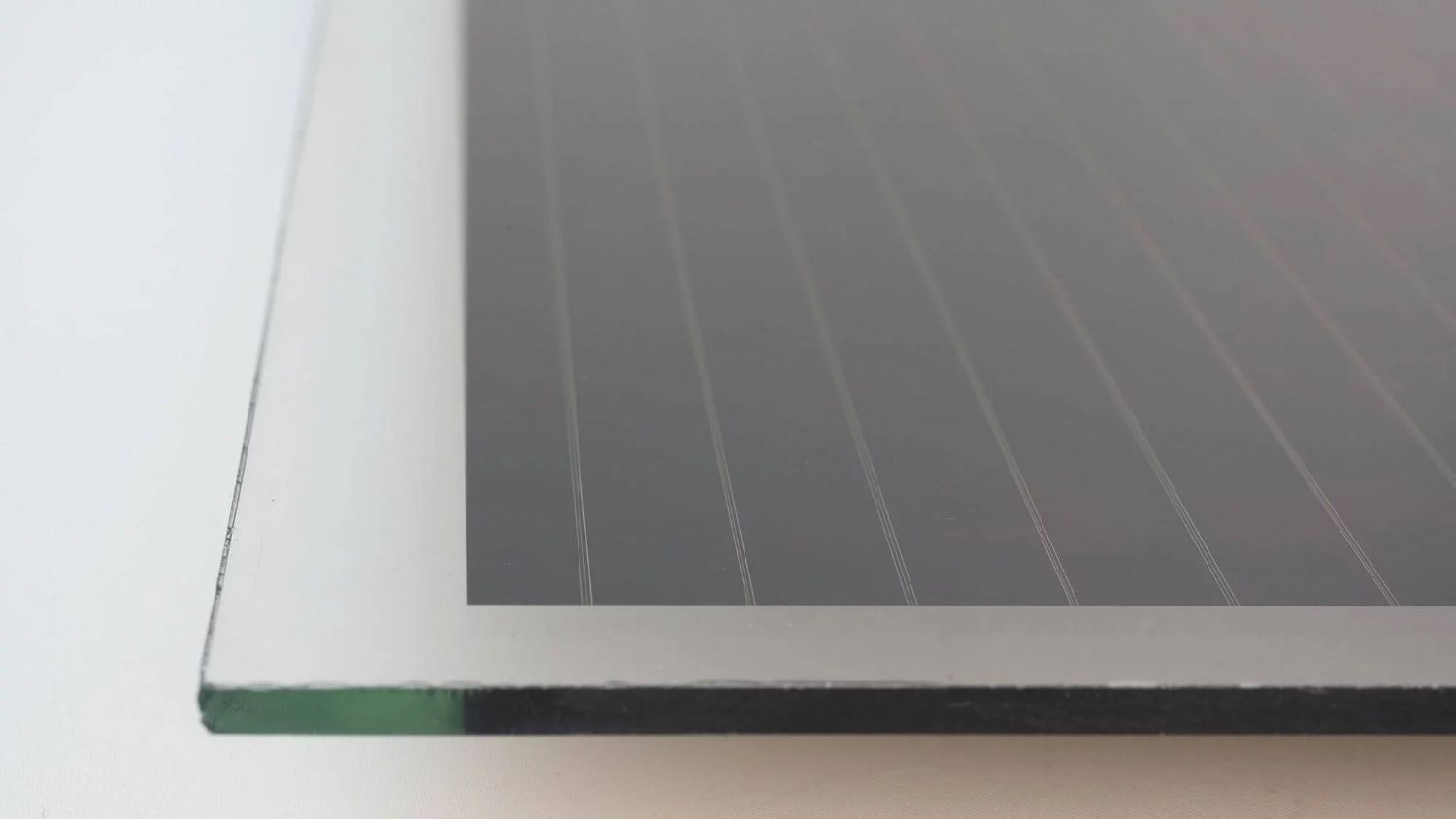
LASER EDGE DELETION
Laser edge deletion is a touchless process with no damage to the substrate. It also does not produce microcracks. It is an environmentally friendly and dry process that works without blasting media or chemicals. No post-cleaning is necessary. Further advantages over mechanical blasting processes or the use of grinding wheels are the reproducibility of the results and the increased module efficiency due to the reduction of the dead zone.
LASER EDGE DELETION IN THIN-FILM PHOTOVOLTAIC MODULE PRODUCTION
Laser edge deletion (LED) based on large-focus laser ablation effectively prepares thin-film photovoltaic modules for subsequent hermetic sealing to ensure the modules' longevity. 4JETs TOPAZ LED achieves high ablation rates of up to 80 cm²/s with on-the-fly scanning for highest throughput. A clean and undamaged glass surface in the edge area of thin-film photovoltaic modules, produced by means of laser edge deletion (LED) from 4JET, is an essential prerequisite for durable thin-film modules. The clean glass surface at the edge of the thin-film solar module protects the active layers of the module from environmental influences, acts as a barrier against moisture and steam and thus ensures reliable modules. The contactless laser edge deletion has completely replaced the aggressive mechanical sandblasting or grinding processes.
CLEAN AND UNDAMAGED GLASS SURFACE ACHIEVED BY 4JET'S LASER EDGE DELETION PROCESS (LED)
4JET's laser edge deletion (LED) provides:
electrical resistance > 1 GOhm
deletion rate up to 80 cm²/s and higher
highest productivity